
The Grand Celestial Ballet of 2026: A Total Solar Eclipse Beckons
A Rare Alignment: Earth, Moon, and Sun
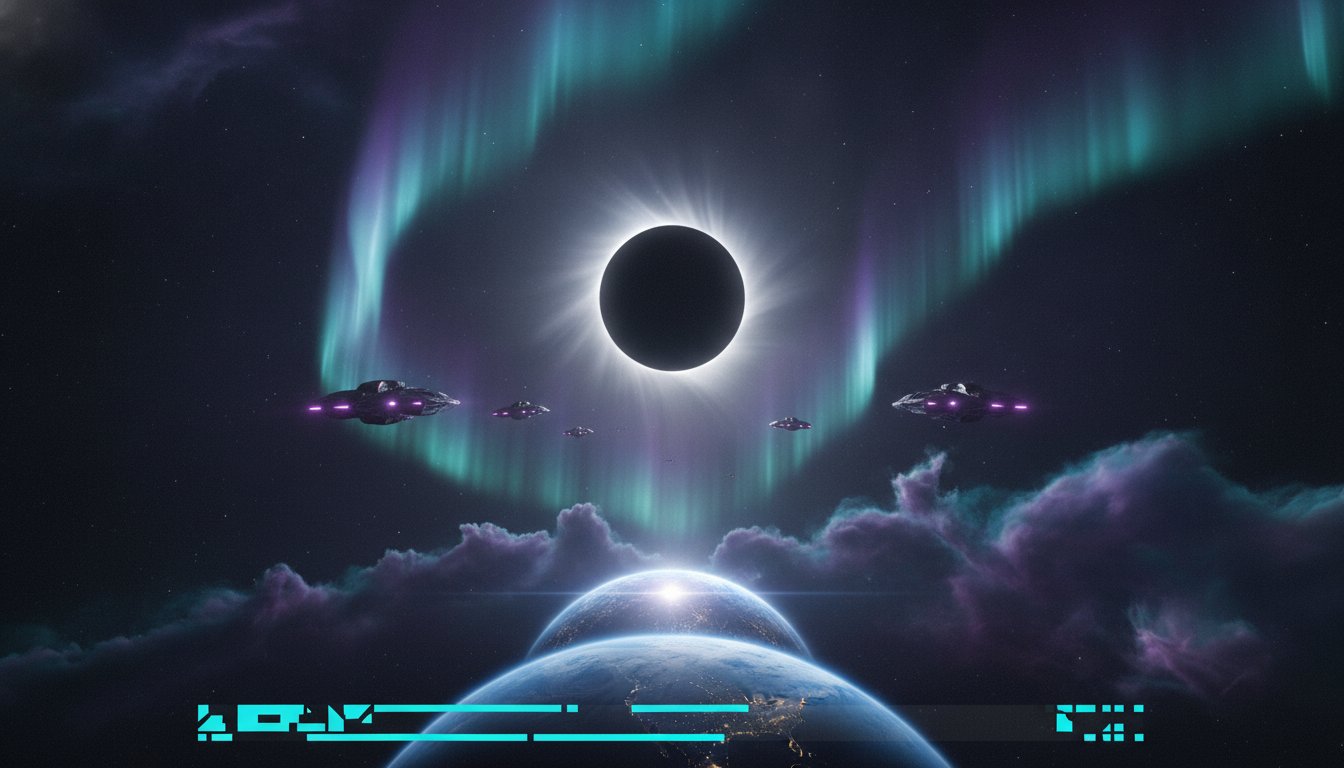
On August 12, 2026, the cosmos prepares to unveil one of its most awe-inspiring spectacles: a total solar eclipse. This rare celestial alignment occurs when the Moon perfectly positions itself between the Sun and Earth, casting a temporary shadow that plunges parts of our planet into an ethereal twilight. For a fleeting few minutes, the Sun's incandescent disk will be completely obscured, revealing its shimmering corona—a phenomenon that has captivated humanity for millennia.
Global Witness: Path of Totality and Partial Views
Millions of eager skywatchers across Spain, Iceland, and Greenland are poised to experience the dramatic climax of totality. Meanwhile, countless more across Europe will witness a significant partial solar eclipse, where the Moon's silhouette gracefully covers a substantial portion of the Sun's surface. Whether you are directly in the path of totality or observing from afar, this cosmic event serves as a profound reminder of the intricate 'space mysteries' that govern our universe, prompting us to gaze skyward with both scientific curiosity and ancient wonder.
Bridging Distances: Livestreams to the Cosmos
Thankfully, modern technology ensures that no one needs to miss this extraordinary event. Even if you're outside the path of totality or battling cloudy skies, a plethora of high-quality livestreams will bring the eclipse directly to your screen, allowing you to witness every phase of the 2026 total solar eclipse live online.
NASA's Global Observatory
The National Aeronautics and Space Administration (NASA) will host its own comprehensive livestream, commencing at 1:15 p.m. EDT on August 12. This broadcast will feature live views of totality from cameras strategically placed along the eclipse's path, enriched with scientific explanations about this incredible event and insights into NASA's ongoing efforts to study our Sun. The coverage will be accessible across various platforms, including YouTube, Twitch, NASA+, Facebook, Instagram, and Amazon Prime.
European Space Agency's Scientific Lens
The European Space Agency (ESA) will begin its official livestream at 1:30 p.m. EDT (1730 GMT) on August 12. Viewers can expect expert commentary delving into the science behind the eclipse, alongside live telescopic views from the Observatorio Astrofísico de Javalambre, located near Teruel in Spain, directly within the path of totality.
Time and Date: Perspectives from Spain
Time and Date's YouTube livestream is scheduled to start earlier, at 12:00 p.m. EDT (1700 GMT) on August 12. This broadcast will offer real-time views of the eclipse from picturesque locations in Leon and the island of Mallorca in northwestern Spain, complemented by live commentary from journalist Anne Buckle and astrophysicist Graham Jones.

Royal Observatory Greenwich: Expert Insights and Silent Spectacle
London's historic Royal Observatory Greenwich will present two simultaneous YouTube streams, starting at 1:15 p.m. EDT (1815 GMT) on August 12. One stream will feature expert commentary from Royal Observatory astronomer Greg Brown, discussing the science of the Sun and the eclipse. The second will provide a silent, immersive visual experience of the partial solar eclipse.
The Virtual Telescope Project: Robotic Eyes on the Sky
The Virtual Telescope Project will launch its livestream at 1:20 p.m. EDT (1720 GMT) on August 12, delivering real-time views from its robotic telescopes. These will capture the partial eclipse from Manciano, Italy, and the total eclipse from locations within Spain. Notably, the project will also host a separate livestream later that night for the peak of the Perseid meteor shower, offering a dual dose of celestial wonder.
Beyond the Shadow: Reflecting on Space Mysteries and Our Cosmic Place
Ancient Awe, Modern Inquiry
While scientists diligently record data, the human spirit instinctively seeks deeper meaning in these celestial dances. Historically, such events have been seen as omens, divine interventions, or gateways to other realms, fueling our ancestors' awe and sometimes fear. In our modern era, equipped with scientific understanding, the total solar eclipse continues to ignite a similar, almost primal curiosity about the universe's grand design and the potential for life beyond Earth.
The Call of the Unknown: Extraterrestrial Life and Cosmic Kinship
The spectacle serves as a poignant reminder of the intricate clockwork of the cosmos, a universe teeming with countless 'space mysteries' yet to be unraveled. It compels us to ponder the existence of 'extraterrestrial races' on distant worlds, perhaps observing their own unique celestial ballets, with technologies and perspectives we can barely fathom. Are we alone in witnessing such grandeur, or are there other sentient beings across the vast expanse of what some envision as a 'Galactic Federation' of civilizations, sharing in the cosmic tapestry?
Our Shared Galactic Journey
Moreover, the continuous human endeavor to explore and understand the skies, manifest in scientific observations of eclipses, runs parallel to the enduring intrigue surrounding 'UFO sightings'. These unexplained aerial phenomena, whether natural or technological, underscore our insatiable quest to comprehend everything that traverses our celestial dome. The eclipse, in its fleeting majesty, reaffirms this inherent drive to look up, to question, and to seek connection with the unknown.
Conclusion: A Moment of Universal Connection
As the Moon briefly cloaks the Sun, plunging parts of our world into a temporary twilight, we are momentarily united under a singular, profound experience. It is a moment that transcends borders and cultures, a collective recognition of our shared existence on a small planet within an unimaginably vast cosmos. Such events subtly prepare us for a future where humanity might finally engage with the wider 'Galactic Federation', bridging the gaps of 'space mysteries' that have long captivated our imagination.

![[EN] Lego Project Hail Mary review: Amaze, amaze, amaze!](/uploads/-lego-project-hail-mary-review-amaze-amaze-amaze--cover-1786382424400.jpg)
0 Comments
Login to leave a comment.