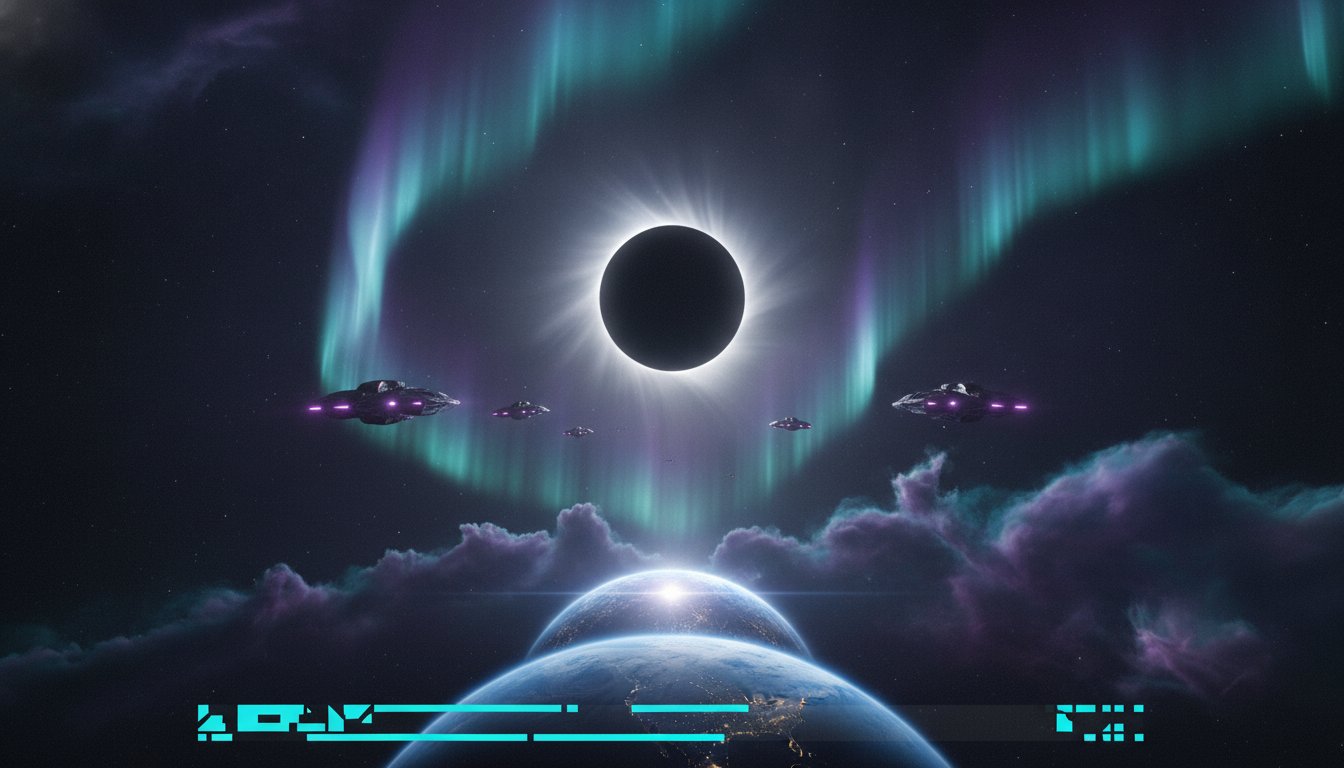
As the cosmos orchestrates its grand performances, few events captivate humanity like a total solar eclipse. On August 12, 2026, the moon will once again cast its profound shadow across Earth, offering skywatchers in Greenland, Iceland, and northern Spain an unparalleled spectacle as day briefly yields to an ethereal twilight. Beyond the dramatic unveiling of the sun's pearly corona, an even rarer cosmic ballet might unfold: the simultaneous appearance of the northern lights.
The Allure of a Dual Celestial Spectacle
The idea of seeing the aurora borealis during a total solar eclipse ignites the imagination. During totality, the sky dims to a luminosity akin to civil twilight – that fleeting period just after sunset when the first stars might emerge. For eclipse chasers situated within the auroral zone, particularly in Greenland and Iceland, this raises a tantalizing question: could the otherworldly glow of the northern lights merge with the haunting beauty of the eclipsed sun?
Independent astronomer Tom Kerss, known for his work as Chief Aurora Chaser for Hurtigruten, confirms that while uncommon, it is "by no means impossible." Kerss himself has photographed auroras in Norway during twilight conditions, proving that sufficiently bright displays can indeed pierce through the lingering daytime glow. However, he cautions that the sun's corona, even during totality, would likely outshine any auroras in its immediate vicinity, meaning visible displays would need to appear in other parts of the sky.
Unraveling the Scientific Odds
For such a phenomenon to occur, the celestial mechanics and atmospheric conditions must align with improbable precision. Kerss emphasizes that the likelihood is "not very high" under normal circumstances. Even though some auroral energy is present in the dayside auroral oval, it's typically too faint to be observed. The key, he explains, lies in extreme solar activity.
The Geomagnetic Imperative
To have any realistic chance of witnessing the northern lights during the eclipse, Earth would need to be engulfed by a severe geomagnetic storm. These powerful disturbances are triggered when colossal eruptions from the sun, such as coronal mass ejections (CMEs), collide with Earth's magnetic field. Such impacts can dramatically intensify auroral displays, making them brighter and more widespread. Kerss suggests that a G4 or even a G5 geomagnetic storm – the most powerful category – would be essential for dayside aurora visibility, as observers will be within Earth's sunlit hemisphere during totality.
Pål Brekke, a distinguished solar physicist and northern lights expert at the Norwegian Space Agency, echoes these sentiments, drawing from his own experience. During the 2015 total solar eclipse over Svalbard, Brekke attempted to spot auroras but found the sky never achieved sufficient darkness, partly due to light reflected from the snow-covered landscape. He also points out a critical timing factor: totality over Greenland and Iceland occurs in the afternoon. Unlike the nightside auroral oval, which expands dramatically during geomagnetic storms, the dayside oval remains relatively stable, making auroras inherently more challenging to discern.
For observers in Spain, the odds are even slimmer. Brekke calculates the need for an extremely rare KP=9 geomagnetic storm, combined with the fact that 20:00 UTC (around the time of totality for Spain) is still early, meaning the most active part of the auroral oval would likely not be positioned overhead.
A Cosmic Trifecta: Eclipse, Aurora, and Meteors
While the chances of seeing the northern lights are slim, there is one scenario that could transform the 2026 eclipse into an unprecedented cosmic event. If the sun were to unleash powerful CMEs in the days leading up to August 12, creating the necessary geomagnetic storm, and if this coincided with the peak of the exceptional Perseid Meteor Shower – which also occurs on that date – then eclipse chasers in Greenland or Iceland could potentially witness three of the sky's greatest wonders simultaneously. This breathtaking alignment would offer an unparalleled spectacle for those fortunate enough to be under the path of totality.
An Unforgettable Spectacle, Regardless
The odds may be stacked against this celestial confluence, but they are not zero. The possibility alone adds an extra layer of intrigue to an already magnificent event. However, regardless of whether the aurora makes a fleeting appearance, the total solar eclipse of August 12, 2026, promises to be one of nature's most profound and awe-inspiring spectacles. The sun's corona, a sight rarely glimpsed, will undoubtedly command all attention, delivering an unforgettable experience to all who witness it.

0 Comments
Login to leave a comment.