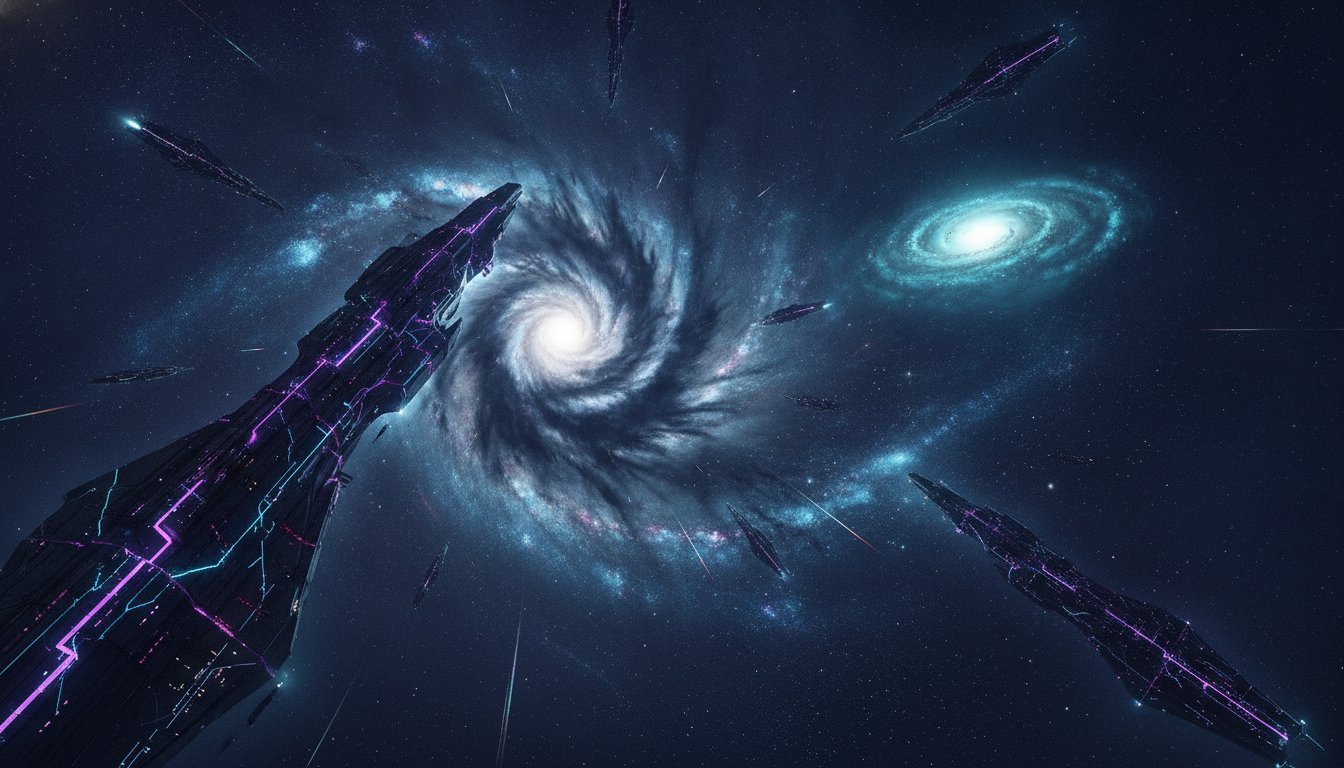
Andromeda Under Siege: Is a Smaller Neighbor Stifling Its Star Formation?
The cosmos is a dynamic arena, teeming with gravitational ballet and titanic forces that shape galaxies over eons. Our nearest galactic neighbor, the majestic Andromeda (M31), stands as a prime example of this cosmic drama. For decades, astronomers have observed its grand spiral arms, but recent revelations from the venerable Hubble Space Telescope are peeling back layers of its tumultuous past, suggesting that Andromeda might be experiencing a peculiar form of cosmic "bullying" from a much smaller companion. This groundbreaking research hints at a dramatic deceleration in Andromeda's star-making factory, with the diminutive galaxy M32 emerging as the prime suspect.
Unveiling Andromeda's Recent History
Astronomers have long known that Andromeda underwent a colossal burst of star formation approximately 2 billion years ago, likely triggered by an ancient collision with an as-yet-unidentified galaxy. Following this stellar boom, the rate of new star births steadily declined. However, the precise timeline and the abruptness of this deceleration remained one of the many space mysteries shrouding our galactic twin. Thanks to meticulous observations by the Hubble Space Telescope, a research team led by Tobin Wainer, a graduate student at the University of Washington, has now painted a clearer picture of Andromeda's more recent past, revealing a surprisingly rapid slowdown in stellar creation over the last 40 million years.
"We can't explicitly say that we are seeing a decrease in star formation because of M32. But it's right there, and it's definitely the most likely suspect," stated Wainer, acknowledging the compelling evidence. This discovery not only fills crucial gaps in Andromeda's evolutionary story but also offers a compelling case study into the destructive potential of galactic interactions, even between vastly different-sized celestial bodies.
The Hubble's Keen Eye: A Cosmic Census
Andromeda, located a mere 2.5 million light-years from Earth, is close enough for Hubble's advanced optics to resolve individual stars. Over several years, Hubble undertook two comprehensive surveys of Andromeda, meticulously cataloging stars brighter than our own Sun. These monumental efforts culminated in a compendium of over 200 million stars, covering a remarkable two-thirds of Andromeda's expansive disk.
To reconstruct Andromeda's star formation history, Wainer and his colleagues ingeniously divided this vast cosmic canvas into a grid of squares, each roughly 300 light-years across. By analyzing the colors of the stars within each square, they could infer the recent stellar activity:
- Bright blue stars: These indicate recent star formation, as blue stars are typically younger and burn hotter and brighter.
- Smaller, redder stars: These signify older, longer-lived stars, suggesting an area that hasn't seen new star births in a considerable amount of time.
Through this detailed stellar census, the team pieced together a compelling narrative of Andromeda's declining stellar productivity.
A Dramatic Deceleration: Andromeda's Starlight Fades
The reconstructed timeline revealed a significant shift. Around 500 million years ago, Andromeda was a prolific star factory, converting gas and dust into new stars at a rate equivalent to our Sun's mass annually. This rate steadily diminished over geological timescales. By approximately 40 million years ago, the pace had halved, dropping to about one-half of the Sun's mass per year. What followed was a particularly dramatic deceleration, bringing the current rate down to a mere one-fifth of the Sun's mass each year.
Intriguingly, the slowdown wasn't uniform across the galaxy. The astronomers discovered that Andromeda's starmaking slump is particularly pronounced on one specific side, with this asymmetry becoming noticeable about 60 million years ago. This particular region of Andromeda is known to be in close proximity to M32, one of its satellite galaxies.
M32: The Galactic Troublemaker?
M32 has been under suspicion by astronomers for some time. Situated a mere 16,000 light-years from Andromeda's core, M32 presents a curious appearance: it looks like the stripped-down, dense core of what was once a larger spiral galaxy, now devoid of its original spiral arms. This fragmented morphology strongly suggests a past, violent encounter with its colossal neighbor, Andromeda. It's plausible that M32, in its close passes, has gravitationally disrupted Andromeda's gas clouds, either stripping them away or heating them, thus hindering their ability to collapse and form new stars. The observed lopsided slowdown in Andromeda's star formation, particularly on the side facing M32, lends strong credence to the hypothesis that this smaller galaxy is indeed the cosmic bully.
Looking Ahead: The Roman Space Telescope
While the evidence pointing to M32 is substantial, definitive confirmation awaits further observations. Fortunately, astronomers won't have to wait long. The Nancy Grace Roman Space Telescope, slated for launch in late August, promises to be an even more powerful eye on the universe than Hubble. Roman will possess an unprecedented field of view and superior resolution, allowing it to survey an even greater expanse of Andromeda's stellar population. In the coming years, Roman's data could provide the conclusive evidence needed to fully understand the intricate gravitational dance between Andromeda and its satellite galaxies, unraveling more of the universe's captivating space mysteries.
![[EN] Lego Project Hail Mary review: Amaze, amaze, amaze!](/uploads/-lego-project-hail-mary-review-amaze-amaze-amaze--cover-1786382424400.jpg)
0 Comments
Login to leave a comment.