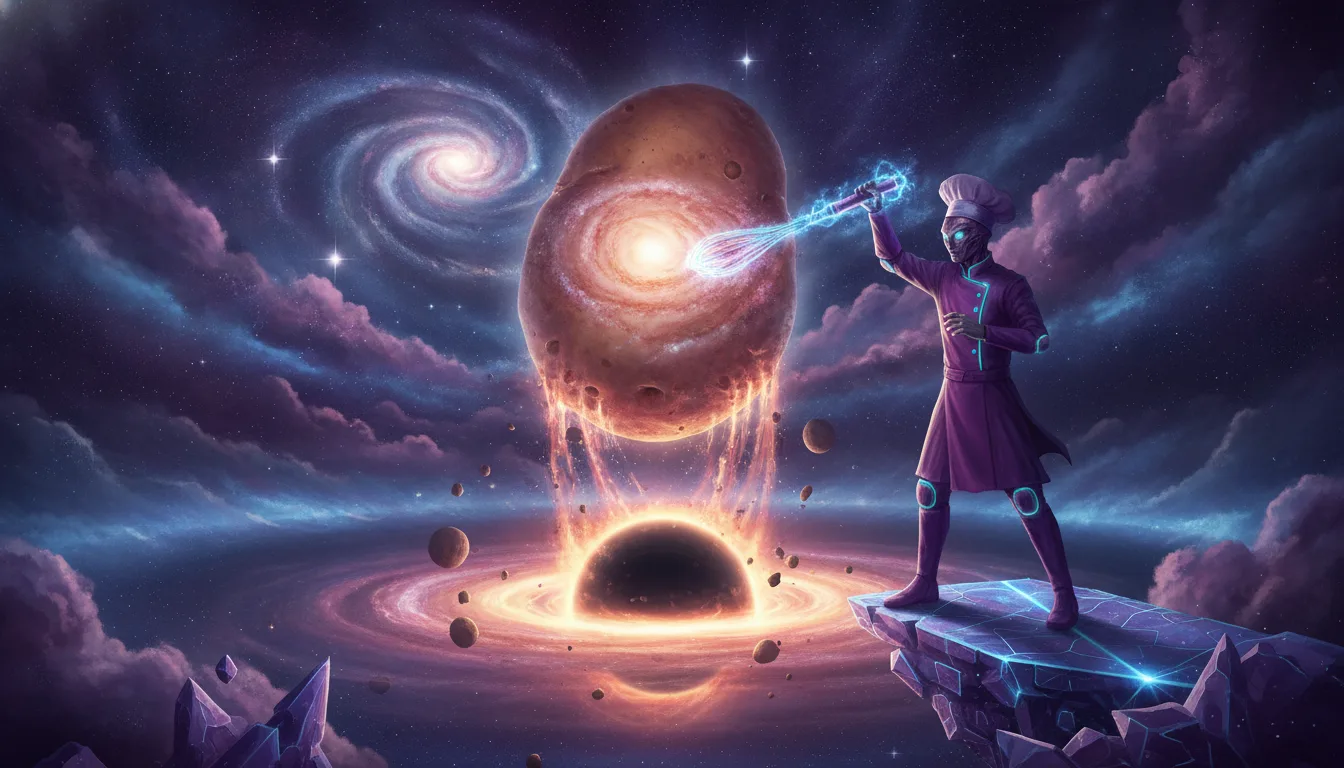
The 'Red Potato' Galaxy: A Cosmic Anomaly from the Early Universe
Far across the vast expanse of space, approximately 11.7 billion light-years from Earth, lies a peculiar galaxy officially designated MQN01 J004131.9-493704. Affectionately nicknamed the "red potato" due to its unusual, blob-like appearance observed by the James Webb Space Telescope (JWST), this celestial body offers a unique window into the universe's infancy, as we see it as it was when the cosmos was a mere 2 billion years old.
Discovered at the intersection of a massive cosmic web — the intricate scaffolding along which galaxies coalesced in the early universe — the red potato presents a baffling paradox. Despite being enveloped by a 'pot' of cold, dense gas, a condition typically ripe for prolific star formation, astronomers found a conspicuous absence of new stellar births within its bounds. This enigma prompted a deeper investigation into the forces at play in this ancient galactic kitchen.
An Unexpected Cosmic Chef: The Supermassive Black Hole's Influence
The mystery began to unravel with observations from the Chandra X-ray spacecraft. What astronomers uncovered was the tell-tale signature of a supermassive black hole jet, vigorously churning and heating the very gas that should have been collapsing to form new stars. This colossal black hole, situated in a neighboring galaxy some 200,000 light-years from the red potato, acts as an unexpected "cook" in this cosmic kitchen, as aptly put by team leader Weichen Wang of the University of Milan-Bicocca in Italy.
The Mechanism of Stellar Suppression
Normally, cold, dense gas clouds cool further and gravitationally collapse, giving birth to dazzling new stars. However, in the case of the red potato, the black hole's powerful jet injects tremendous energy into the surrounding gas. This energy heats the gas, preventing it from cooling down sufficiently to collapse and ignite stellar nurseries. The turbulence observed in the red potato's gas envelope, unlike the calmer clouds around similar galaxies, was the initial clue pointing to this external interference.
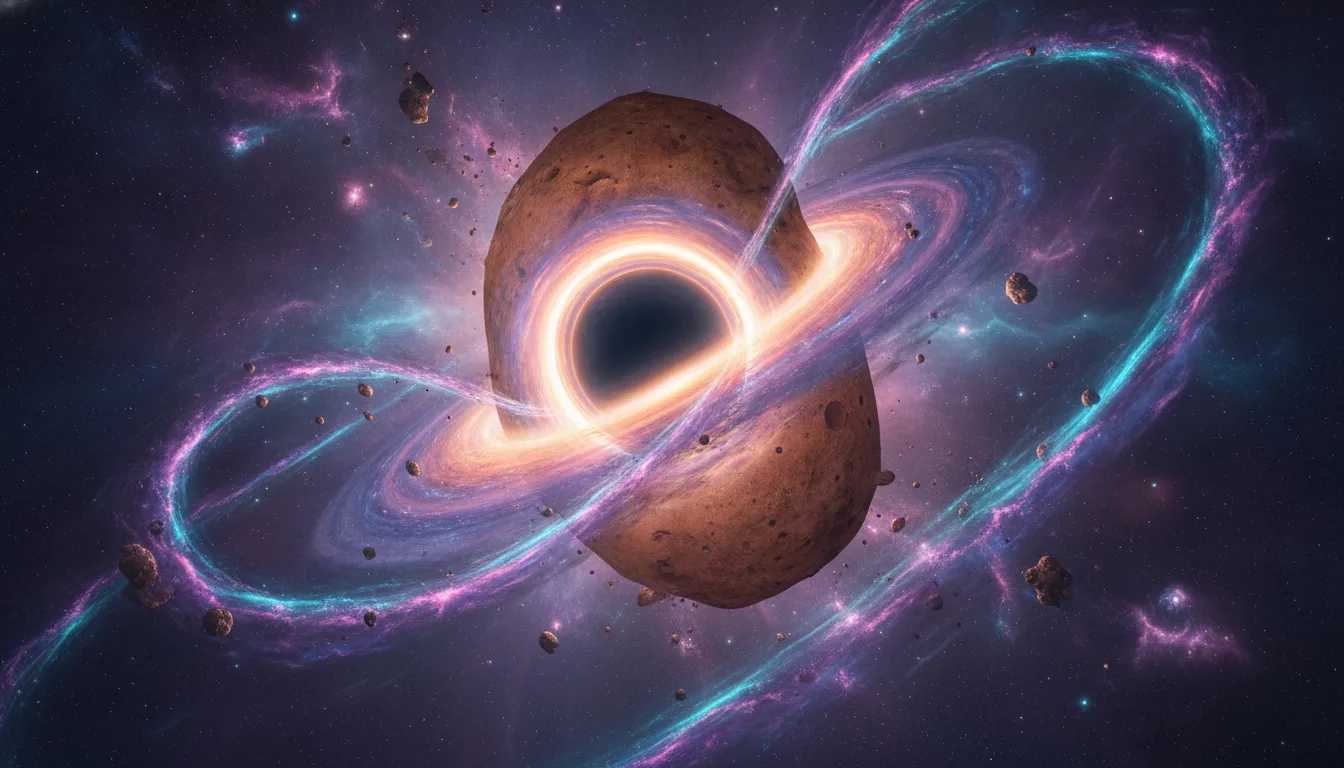
"Stars are not forming like we thought they would, so we went searching for the reason why," Wang stated. "We found there may be a cook in this cosmic kitchen."
Team member Sebastiano Cantalupo further elaborated on the implications: "If the black hole's jet is stirring up the gas around the red potato, it could greatly slow down how quickly the galaxy can acquire new, fresh material to form stars. With the energy from the stirring, the galaxy will starve and not be able to produce new stars at the rate expected for similar galaxies at the same cosmic epoch."
A Tale of Interacting Galaxies in the Early Universe
Intriguingly, the supermassive black hole responsible for stifling star formation in the red potato resides in a galaxy that is, itself, actively birthing new stars. Furthermore, other galaxies in the red potato's immediate vicinity are also thriving with stellar production. This stark contrast underscores the complex and often localized nature of galactic interactions in the early universe, where a powerful black hole's influence can extend far beyond its host galaxy, shaping the destinies of its neighbors.
This groundbreaking research, published on July 7 in the journal Astronomy & Astrophysics, is among the first to delve into the intricate behavior of gas in non-star-forming galaxies at such an early epoch. It provides vital insights into the cosmic processes that govern galaxy evolution and how neighboring celestial structures can interact and, at times, interfere with each other's developmental trajectories.
As Andrea Travascio, another team member from the University of Milan-Bicocca, eloquently noted, "The red potato is leaving crumbs of information that may help us track down the answers to some really big questions. Quite an important job for a galactic spud like this."
Understanding these distant cosmic kitchens and their powerful chefs is crucial for painting a more complete picture of how the universe evolved from its nascent state into the star-studded tapestry we observe today.
0 Comments
Login to leave a comment.