
Unveiling the Moon's Newest Scar: SpaceX Rocket's Impact Crater Imaged by Danuri Orbiter
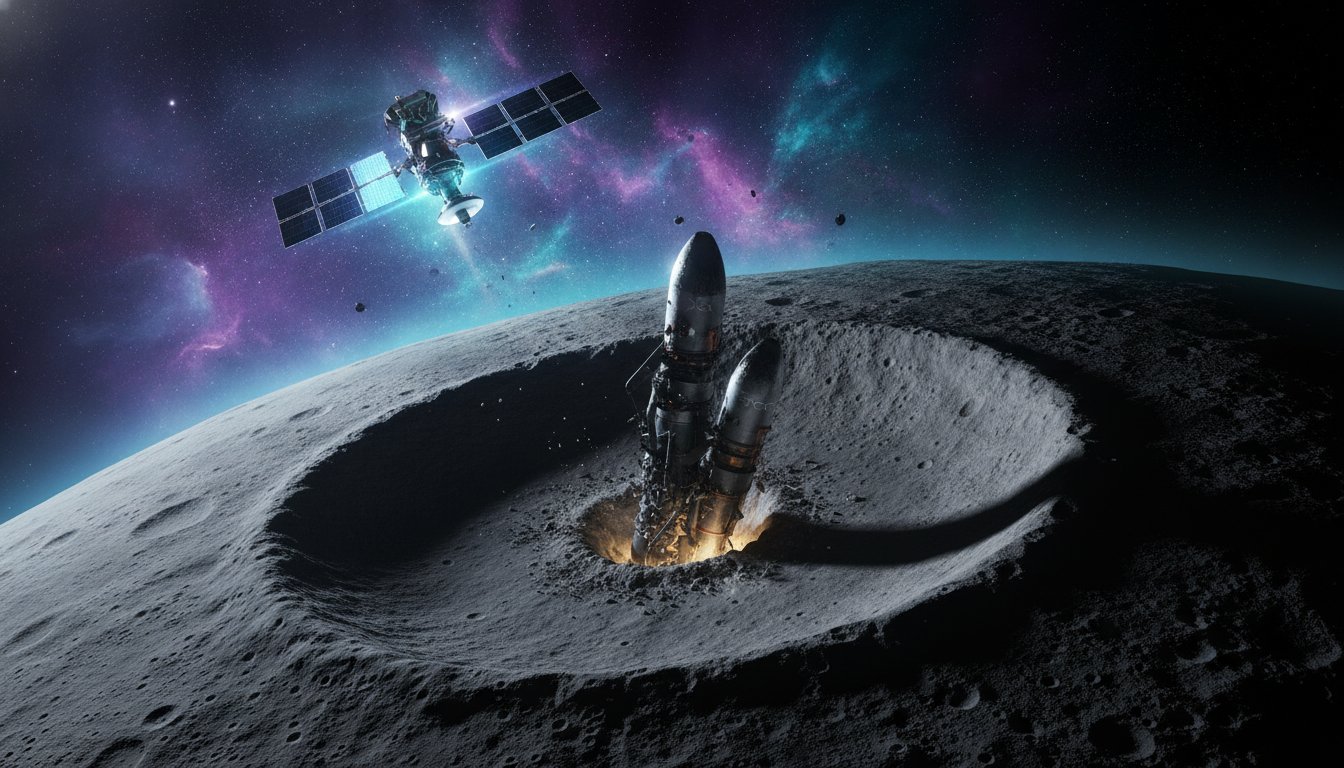
The silent, majestic expanse of the Moon recently bore witness to a unique cosmic event: the forceful impact of a human-made object, a discarded upper stage of a SpaceX Falcon 9 rocket. The resulting crater, a fresh scar on the ancient lunar surface, has now been meticulously captured by South Korea's pioneering Korea Pathfinder Lunar Orbiter, known as Danuri, offering unprecedented insights into orbital mechanics and lunar geology. This remarkable discovery, confirmed by officials with the Korea Aerospace Research Institute (KARI), marks a significant moment in our understanding of space debris and its interactions with celestial bodies.
The Precise Moment of Impact and Discovery
The fateful collision occurred at 2:34 a.m. EDT (0634 GMT) on Wednesday, August 5th, precisely aligning with scientists' prior calculations. The 8,800-pound (4,000 kilograms) Falcon 9 upper stage, traveling at an estimated speed of 5,400 mph (8,690 kph), gouged out a substantial crater on the lunar far side, predicted to be up to 89 feet (27 meters) wide.
Danuri, South Korea's first lunar probe, proved instrumental in documenting this rare occurrence. KARI officials reported that Danuri initiated observations approximately 30 minutes before the predicted impact. Through expert orbit control, the orbiter conducted a total of eight imaging sessions, passing over the impact site multiple times. Its high-resolution cameras secured both pre-collision and immediate post-collision footage, providing crucial "before-and-after" data. This unique capability allowed researchers to confirm definitive changes in the terrain around the impact site and clearly observe traces of ejected material spread across the lunar regolith, making it invaluable research data for understanding the dynamics of such high-velocity cosmic events.
The Unintended Journey of a Space Relic
The Falcon 9 upper stage responsible for this lunar alteration embarked on its mission much earlier. Launched on January 15, 2025, it successfully delivered two private robotic moon landers—Firefly Aerospace's Blue Ghost and ispace's Resilience—to a high, moon-crossing Earth orbit. While Blue Ghost achieved a successful soft landing on the Moon on March 2nd of that year, Resilience tragically crashed during its own touchdown attempt.
Unlike the reusable first stages of Falcon 9 rockets, which return to Earth for recovery, the upper stages are typically expendable. SpaceX usually maneuvers them to burn up safely in Earth's atmosphere. However, the upper stage from the Blue Ghost-Resilience mission consumed nearly all of its propellent getting its payloads to their distant lunar destination. Left without sufficient fuel for a controlled atmospheric re-entry, the massive rocket body remained in a highly elliptical Earth orbit. Over time, the subtle but relentless influence of solar activity and gravitational forces slowly but surely nudged this derelict space junk onto an irreversible collision course with the Moon, turning it into an unforeseen agent of lunar modification.
A History of Human-Made Lunar Scars
While the SpaceX impact might seem novel, it is far from the first time human technology has deliberately or accidentally marred the lunar surface. The Moon has served as an unintended graveyard for various space missions and their components throughout the space age. Notable past incidents include:
- China's Long March 3C: On March 4, 2022, the third stage of a Chinese Long March 3C rocket also crashed into the lunar surface.
- NASA's Apollo Missions: The third stages of NASA's mighty Saturn V rockets were intentionally crashed into the Moon during multiple Apollo missions. These controlled impacts were crucial for seismic experiments, allowing instruments left by astronauts to study the Moon's internal structure.
Each of these events, whether planned or accidental, contributes to a growing scientific dossier on lunar impacts and the long-term fate of objects in Earth-Moon space. They help unravel some of the subtle space mysteries surrounding gravitational interactions and the resilience of celestial bodies.
International Collaboration and Future Insights
The comprehensive observation data secured by Danuri is not merely an isolated discovery. KARI officials have indicated that this information will be meticulously analyzed and linked with follow-up observations from other lunar probes, specifically NASA's Lunar Reconnaissance Orbiter (LRO). This international collaborative research effort promises to verify pre-impact predictions with unparalleled accuracy and refine our models of orbital dynamics and impact physics.
Furthermore, there is a possibility that some ground-based telescopes also witnessed the event. Astronomers at the Instituto de Astrofísica de Andalucía in Spain, for instance, believe they captured video footage of ejected material blasting off the lunar surface around the predicted impact time, providing additional corroboration from a different observational vantage point.
Danuri itself is a testament to South Korea's burgeoning capabilities in space exploration. Launched on August 4, 2022, and reaching lunar orbit four months later, it carries six sophisticated payloads. Five of these instruments are provided by Korean universities and research organizations, while the sixth is NASA's ShadowCam, an instrument designed to hunt for signs of water ice in the Moon's permanently shadowed polar regions, adding another layer to our ongoing quest to understand Earth's closest celestial neighbor.
The mapping of this new crater by Danuri serves as a powerful reminder of humanity's ever-expanding footprint in the cosmos, even through its discarded relics. It underscores the importance of continued space observation, not only for future missions but also for understanding the consequences of our current activities beyond Earth.




0 Comments
Login to leave a comment.