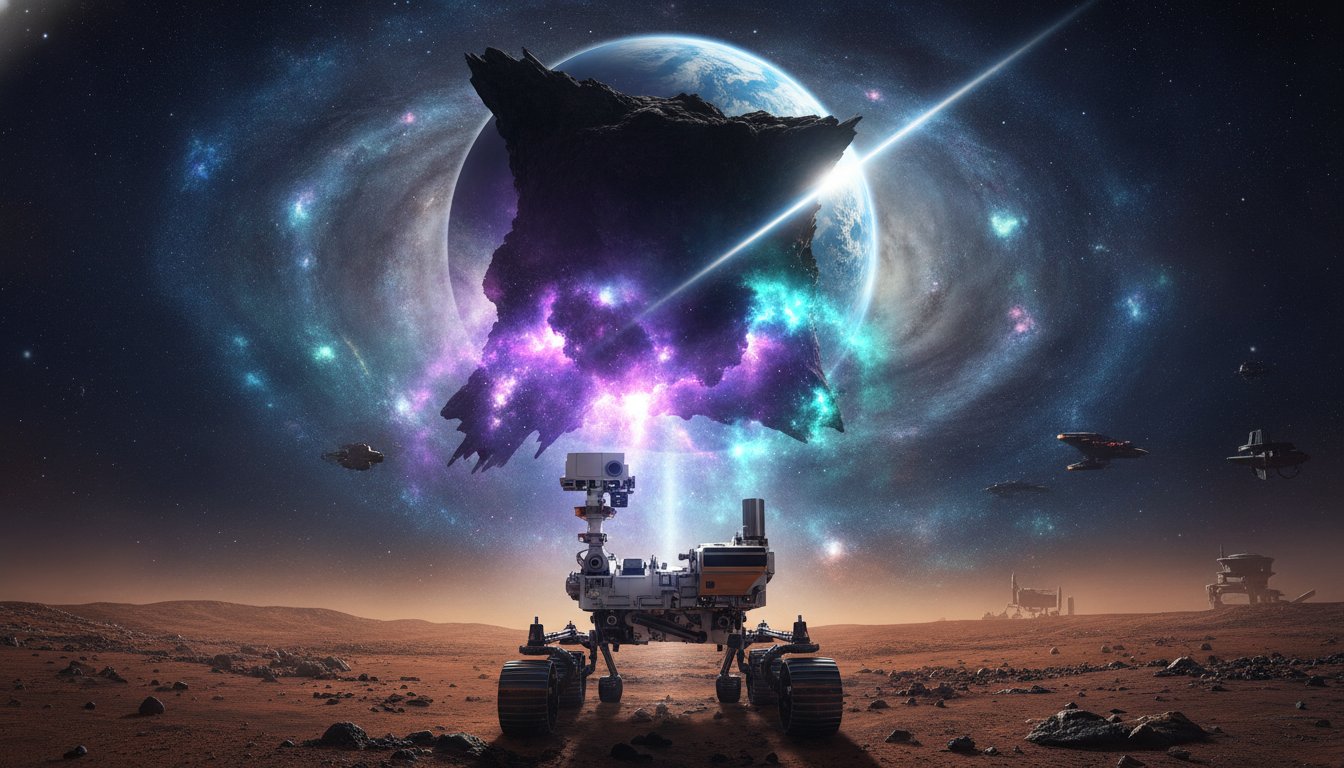
A Celestial Ballet: Earth's Brief Occultation by Mars' Moon Phobos
From its vantage point on the dusty plains of Jezero Crater, NASA's Mars Perseverance rover recently offered humanity a unique and breathtaking perspective on our home planet. On July 2, 2026, the 1,907th Martian day of its pioneering mission, Perseverance captured a rare celestial event: Earth briefly disappearing behind Phobos, the larger and innermost of Mars' two enigmatic moons. This extraordinary observation, meticulously recorded by the rover's Mastcam-Z instrument, not only provides stunning imagery but also invaluable scientific data, deepening our understanding of orbital mechanics and the dynamic Martian sky.
The Science Behind the Spectacle: Understanding Occultations
The phenomenon witnessed by Perseverance is known as an occultation, a term derived from the Latin word 'occultare,' meaning 'to hide.' An occultation occurs when one celestial body passes in front of another, obscuring it from view. While Earth-bound observers are familiar with our own Moon occulting distant stars or planets, seeing our home planet briefly vanish behind a Martian moon offers a profound sense of cosmic perspective. The composite image, consisting of nine distinct frames, shows Earth as a pale, bright dot in the hazy Martian sky, momentarily eclipsed by the potato-shaped silhouette of Phobos.
Such events are crucial for planetary scientists. By precisely timing these occultations, researchers can refine their models of Phobos's orbit, which is notoriously complex due to its close proximity to Mars and its irregular shape. These observations contribute to a more accurate understanding of the gravitational interactions within the Martian system, crucial for future missions, including potential human landings.
Mars' Enigmatic Moons: Phobos and Deimos
Mars boasts two small, irregularly shaped moons, Phobos and Deimos, a stark contrast to Earth's single, large companion. Phobos, with a diameter of about 22 kilometers, orbits incredibly close to Mars, completing three orbits per Martian day. Deimos, even smaller at about 12 kilometers, orbits further out. The origins of both moons remain a subject of active scientific debate. Are they captured asteroids from the main asteroid belt, pulled in by Mars' gravity? Or are they remnants of a colossal impact on Mars in its ancient past, much like Earth's Moon is believed to have formed? Observations of occultations and transits (when a moon passes in front of the sun, creating a 'Martian solar eclipse') by missions like Perseverance help gather data that can shed light on these profound space mysteries.
A Triumph of Planning and Precision
Capturing such a fleeting moment required an impressive combination of sophisticated technology, meticulous planning, and a touch of serendipity. Mark Lemmon, a Mastcam-Z co-investigator at the Space Science Institute, highlighted the challenge: "Phobos crosses the Martian sky three times a day, and Earth is visible for months at a stretch, but catching one directly behind the other takes planning and a little luck." The ability of NASA's Jet Propulsion Laboratory (JPL) to precisely program Perseverance's Mastcam-Z instrument to track and image this rare alignment underscores the incredible capabilities of robotic extraterrestrial exploration.
Beyond this particular occultation, Perseverance has a rich history of sky-gazing. It has previously documented Phobos transiting the sun, offering unique insights into the moon's motion and the Martian atmosphere. These continuous observations provide a dynamic portrait of the Martian environment, contributing vital context to its primary mission of searching for signs of ancient microbial life and collecting samples for eventual return to Earth.
The Ongoing Quest to Unravel Space Mysteries
Every image and data point collected by missions like Perseverance adds another piece to the grand puzzle of our solar system. The sight of Earth as a distant, pale blue dot, briefly hidden by a tiny Martian moon, serves as a powerful reminder of our place in the cosmos and the boundless potential of scientific discovery. As Perseverance continues its journey across the Red Planet, it keeps not just a watchful eye on Martian geology but also on the subtle, yet profound, celestial dances that unfold in the skies above, pushing the boundaries of human knowledge and inspiring a deeper appreciation for the space mysteries that surround us.

0 Comments
Login to leave a comment.