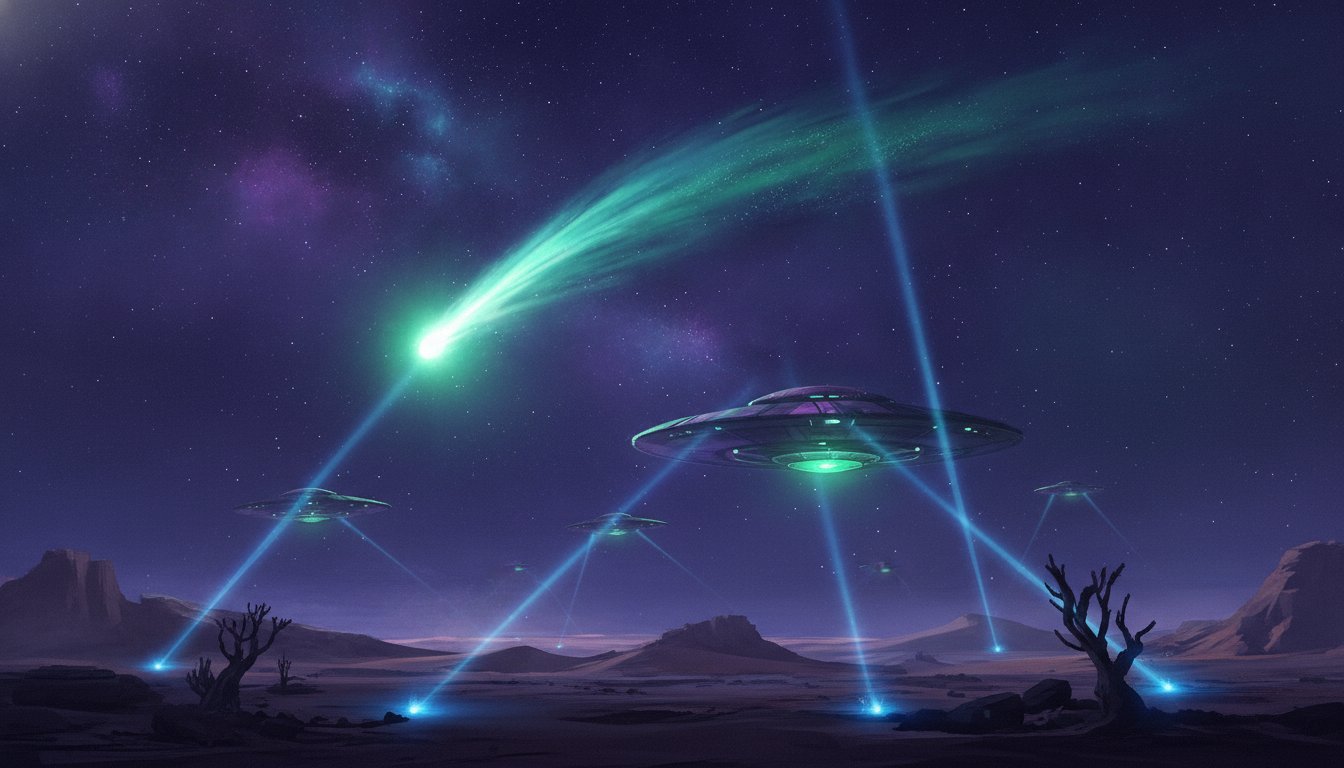
The Emerald Wanderer: Green Comet 220P/McNaught Illuminates Namibian Skies
A Celestial Spectacle Unveiled
In a breathtaking display of cosmic beauty, astrophotographers Gerald Rhemann and Michael Jäger recently captured Comet 220P/McNaught as it blazed across the night sky above Namibia. This stunning photograph, taken on August 8, 2026, showcases the comet's vivid emerald hue and intricate tail, offering a rare glimpse into the dynamic world of celestial wanderers. The image, a testament to both astronomical prowess and the sheer majesty of our universe, quickly became a sensation among space enthusiasts and the scientific community alike. Such high-quality imagery of specific extraterrestrial races or UFO sightings often relies on similar dedication to precision, but here, the focus is squarely on the natural artistry of deep space.
The Journey of Comet 220P/McNaught
Comet 220P/McNaught is named after its discoverer, Australian astronomer Robert H. McNaught. This particular comet is a relatively frequent visitor to our inner solar system, completing an orbit around the Sun approximately every 5.5 years. Its recent appearance has been particularly noteworthy due to a series of dramatic events that significantly enhanced its visibility. In June of this year, the comet reached its perihelion – the point in its orbit where it is closest to the Sun. This gravitational embrace often triggers intense activity, and 220P/McNaught was no exception. It experienced a colossal outburst, an explosive release of gas and dust from its icy nucleus, which astonishingly brightened it by an estimated 8,000 times its normal luminosity.
While such outbursts are a crucial aspect of understanding space mysteries and cometary behavior, they don't always guarantee a prolonged bright display. However, Comet 220P/McNaught had a second act. By August, it had flared up once more, reaching an impressive 600 times its typical brightness. It was during this luminous phase that Rhemann and Jäger seized their opportunity, turning their sophisticated equipment towards the southern African heavens. The clarity of the capture provides invaluable data for those studying these ephemeral space phenomena, helping to chart their paths and predict future celestial events.

Capturing the Ephemeral: Astrophotography at Its Finest
The achievement of capturing Comet 220P/McNaught with such spectacular clarity is a testament to advanced astrophotography techniques. Gerald Rhemann and Michael Jäger utilized a powerful 12-inch Astrograph telescope, paired with a ZWO ASI 6200 MM Pro camera, to immortalize the comet's passage. This combination allowed them to gather enough light and detail to render the comet's greenish glow and delicate tail structures visible against the dark canvas of the Namibian night. The conditions in Namibia, renowned for its pristine, light-pollution-free skies, are ideal for such deep-sky observations, providing a perfect backdrop for the comet's brilliant performance. The meticulous planning and execution required for such a shot highlight the dedication involved in documenting our universe's wonders.
Why This Comet Dazzles
Seeing a comet with the naked eye is a rare occurrence, and even with binoculars or a small telescope, many are often too faint or too distant to make a significant impression. The vibrancy and detail of Comet 220P/McNaught in this photograph, however, underscore its unusual brightness during this period. It offers a tangible connection to the vastness of space, making the often abstract concepts of space mysteries feel immediate and real. For many, witnessing such an event, whether directly or through stunning imagery, evokes a profound sense of wonder and curiosity about our place in the cosmos and the myriad space phenomena that unfold beyond our planet.
Comets, Debris, and Celestial Showers
Beyond their individual beauty, comets play a crucial role in other celestial spectacles: meteor showers. As comets journey through the solar system, they shed trails of dust and debris. When Earth's orbit intersects these trails, these small particles enter our atmosphere, burning up due to friction and creating the streaks of light we commonly know as "shooting stars."
A prime example is the annual Perseid meteor shower, which graces our skies as Earth passes through the debris left by Comet Swift-Tuttle. This long-period comet, with an orbit of 133 years, deposits a vast stream of material. Under dark skies, dedicated skywatchers can observe up to 100 shooting stars per hour during the Perseids' peak, a direct consequence of Swift-Tuttle's icy passage. The green glow of Comet 220P/McNaught and the fiery streaks of a meteor shower are both captivating reminders of the dynamic, ever-changing nature of our cosmic neighborhood. They invite us to look up, ponder the greater universe, and perhaps even contemplate the possibility of other forms of life among the extraterrestrial races that might observe similar celestial ballet from their own vantage points.

0 Comments
Login to leave a comment.