
The Awe-Inspiring Passage of the 2026 Total Solar Eclipse
On August 12, 2026, a celestial event of monumental proportions swept across our planet, captivating millions and etching an unforgettable memory into the annals of skywatching history: a total solar eclipse. This rare cosmic spectacle, where the Moon perfectly aligns to obscure the Sun, plunged parts of Greenland, Iceland, and Spain into a momentary, eerie twilight, offering a profound glimpse into the mechanics of our solar system. Far more than a mere astronomical phenomenon, a total solar eclipse is a deeply visceral experience, known to silence birds, drop temperatures, and evoke a primal sense of wonder in all who witness it.
A Journey Through the Path of Totality
The narrow, approximately 182-mile-wide (293-kilometer) path of totality began its grand sweep near Siberia over the Arctic Ocean, arcing gracefully down into eastern Greenland. From this remote, icy expanse, the Moon's shadow traversed western Iceland before making its dramatic landfall across northern Spain. Millions had gathered in these prime viewing locations, from the rugged fjords of Greenland to the sun-drenched plains of Spain, all eager to experience the fleeting magic of totality.
Space.com's skywatching editor, Daisy Dobrijevic, experienced the eclipse from the deck of the MS Spitsbergen in Scoresby Sund, Greenland. Her account vividly captures the transformative power of the event: "I cannot believe what I just witnessed. I knew what to expect — I've seen thousands of photos but nothing compares to that feeling you get when you watch the sun transform before your very eyes." She spoke of the Sun appearing "so big in the sky with the delicate corona streaming out into the abyss," noting that Jupiter, Mercury, and Venus also "joined in the show." The sight of a "huge prominence" added to the already astounding display, leaving her feeling "privileged to have experienced it in one of the most remarkable environments on Earth."
Further south, in Valoria la Buena, Spain, Space.com skywatching writer Anthony Wood shared a similar sense of disbelief and awe. Witnessing the event alongside a team of citizen scientists, Wood described the experience as "the most incredible thing I've seen in my entire life," adding, "It feels like it really shouldn't be happening. It strikes the lizard part of your brain that just tells you that this shouldn't be real." Such testimonials underscore the unique, almost surreal quality of a total solar eclipse, a true highlight among cosmic events. The path of totality then continued its journey across the Balearic Islands before gracefully exiting over the Mediterranean Sea as the sun dipped below the horizon.
Unveiling the Sun's Hidden Crown: The Solar Corona
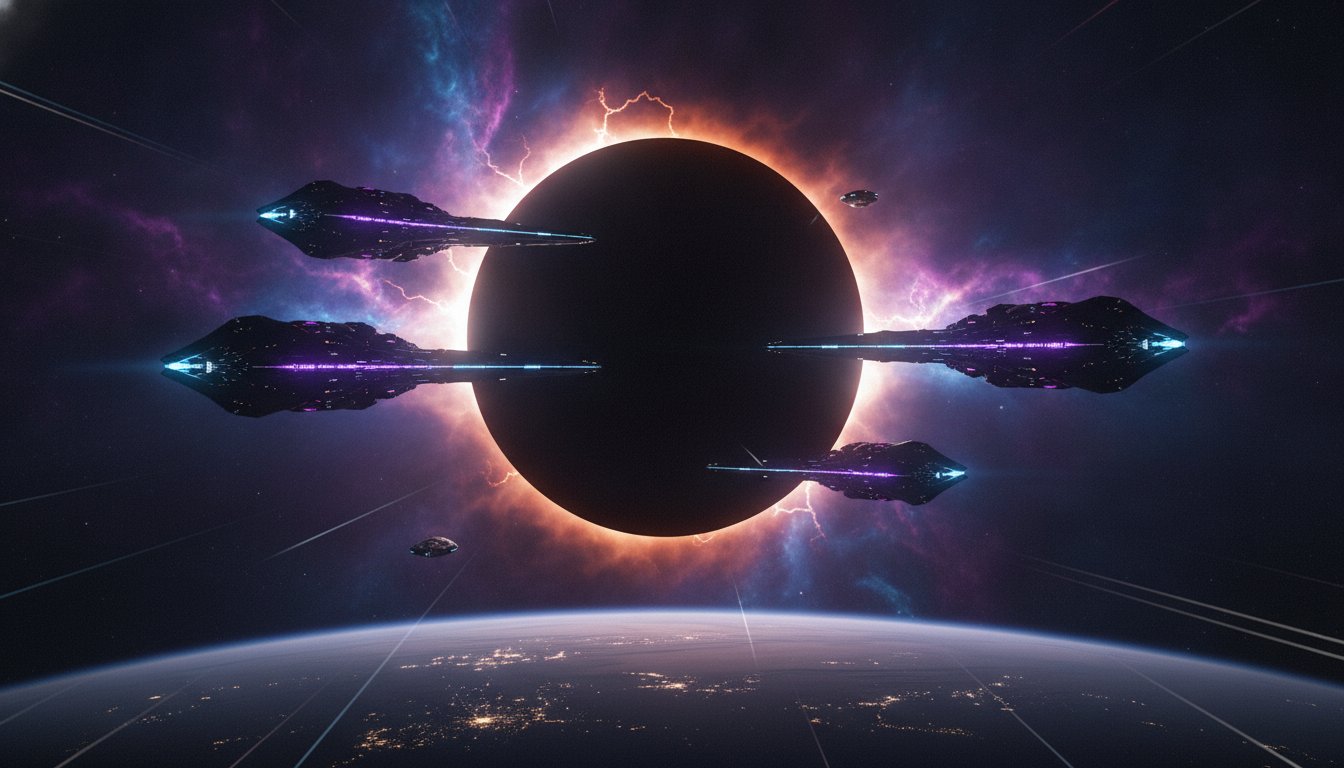
One of the most profound aspects of a total solar eclipse is the rare opportunity it affords to view the Sun's ethereal outer atmosphere, the corona, with the naked eye. Normally obscured by the Sun's blinding disk, the corona appears as a magnificent, crown-like glow, its delicate streamers extending millions of miles into space. This breathtaking sight is notoriously difficult to capture adequately in photographs; its true majesty must be witnessed directly to be fully appreciated. It's a reminder of the intricate beauty and raw power of our nearest star, hidden in plain sight.
The Mechanics of a Total Solar Eclipse
A total solar eclipse is a precise alignment, a celestial dance where the Moon positions itself directly between the Sun and Earth. This perfect cosmic ballet creates a shadow, known as the path of totality, that sweeps across our planet's surface. Only within this narrow corridor do observers experience the full spectacle.
The Moon's elliptical orbit plays a crucial role. For a total eclipse to occur, the Moon must be at an optimal distance from Earth, appearing just large enough in our sky to completely obscure the Sun's dazzling face. This allows the fainter, yet spectacular, corona to become visible. When the Moon is farther away and appears smaller, it results in an annular solar eclipse, where a "ring of fire" remains visible around the Moon's silhouette. These fundamental principles of astronomy highlight the precise conditions required for such a rare display.
A Glimpse Beyond Totality: Partial Eclipses and Future Events
While the path of totality offered the most dramatic views, observers across Europe, Scandinavia, much of the northeastern United States, Canada, and Alaska were treated to a partial solar eclipse. During this phenomenon, the Moon appears to take a "bite" out of the Sun, a fascinating but less intense version of its full counterpart. Space.com's Harry Bennett, for instance, captured stunning views of the partial eclipse from Somerset, England, using advanced skywatching equipment.
For those who missed the 2026 event, the universe offers more opportunities to witness these celestial marvels. The next total solar eclipse is slated for August 2, 2027, with its path spanning southern Spain, northern Africa (Morocco, Algeria, Tunisia, Libya, Egypt, Sudan), Saudi Arabia, Yemen, and Somalia. North America will await its next full spectacle on March 30, 2033, visible from Alaska, followed by a major event on August 23, 2044, crossing parts of Montana, South Dakota, North Dakota, and Canada.
These recurring cosmic spectacles remind us of the dynamic nature of our universe and the profound beauty that unfolds above us. Each total solar eclipse is a fleeting, precious moment, a universal invitation to pause, look up, and connect with the grand mysteries of space.


0 Comments
Login to leave a comment.