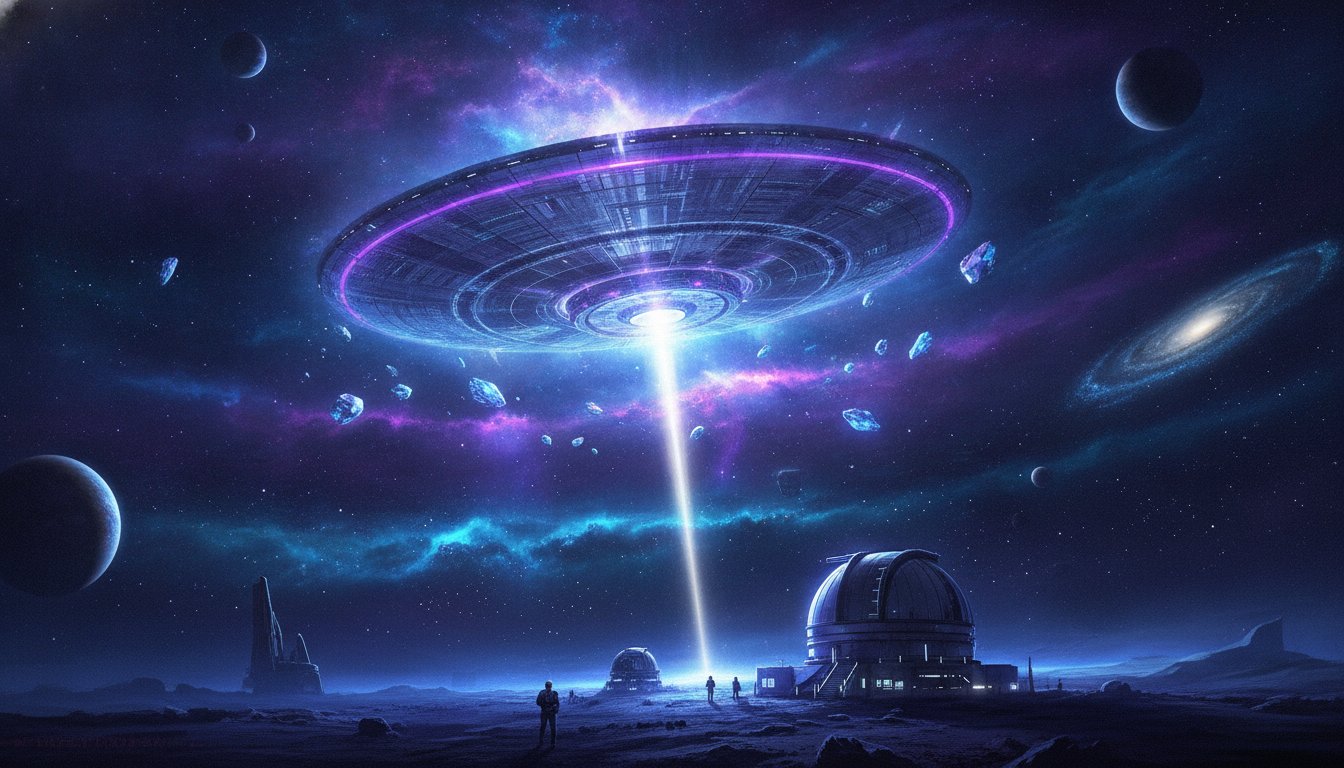
August's Cosmic Canvas: A Celestial Guide to the Night Sky's Evolving Masterpiece
As the summer nights deepen, August transforms into a magnificent cosmic canvas, offering stargazers an unparalleled opportunity to connect with the vastness of the universe. This month, our celestial neighbors put on a stunning display, inviting both seasoned astronomers and curious newcomers to explore the intricate dance of planets across our shared sky. From dazzling evening appearances to rare predawn conjunctions, August is a treasure trove of cosmic phenomena, beckoning us to ponder the mysteries that lie beyond.
Venus: The Evening Star's Paradoxical Descent
Throughout August, Venus, our brilliant 'Evening Star,' commands attention, shining brighter than any other planet. However, its performance this month holds a fascinating paradox. On August 15th, Venus reaches its greatest elongation, positioned 46 degrees east of the sun. Logically, one might expect it to climb higher in the western sky. Instead, Venus will be observed sinking noticeably lower towards the west-southwest horizon as the month progresses.
This intriguing behavior is due to Venus's increasing southerly declination in the sky. As it moves further south of the sun, and coupled with the specific angle of the ecliptic – the apparent path of the sun, moon, and planets – relative to the western horizon during late summer and early fall, Venus begins to set in a progressively brighter twilight. By the second half of August and into September, the planet will no longer grace a truly dark sky, but rather dip below the horizon amidst the fading glow of dusk, still a breathtaking sight, yet a testament to the complex celestial mechanics at play.
Saturn: The Ringed Jewel of the Night
For those equipped with a telescope, August presents an exceptional opportunity to marvel at the "Lord of the Rings," Saturn. Rising in the late evening, Saturn achieves a commanding position high in the south-southeast by dawn. Its iconic rings are currently tilted at an optimal angle for observation, offering a stunning view of this gas giant's intricate system. Observing Saturn provides a profound connection to the grandeur of our solar system, reminding us of the diverse and awe-inspiring worlds that share our cosmic neighborhood. Late on August 3rd, look for Saturn shining to the lower right of a gibbous moon, creating a beautiful celestial pairing.
Mars: The Red Planet's Distant Glow
Mars, the enigmatic Red Planet, becomes visible a few hours before sunrise. While Earth continually closes the vast distance between us and Mars, reducing it by an average of 425,800 miles (685,100 kilometers) daily throughout August, its overall brightening will be gradual. Even at month's end, Mars remains a substantial 172.2 million miles (277.1 million km) away. Consequently, while its luminosity steadily increases, it will still appear as a relatively dim, though noticeable, object in the pre-dawn sky, offering a subtle hint of its ongoing journey towards a closer alignment. On the morning of August 9th, keen observers can find Mars approximately 4.5 degrees to the right of a waning crescent moon.
Mercury and Jupiter: A Dawn Conjunction of Giants and Sprites
Early risers are in for a truly special treat as Mercury, the solar system's innermost planet, and Jupiter, its colossal king, engage in a remarkable celestial ballet around mid-August.
Mercury's Elusive Dance
Mercury starts the month strongly, reaching its greatest elongation from the Sun (19 degrees) on the morning of August 2nd. At magnitude +0.2, it will be clearly visible low in the east-northeast, approximately 50 minutes before sunrise. Its visibility continues through the first half of August, though it will appear lower each dawn. Despite this, Mercury rapidly brightens, transforming from magnitude -0.7 on August 9th to an impressive -1.3 by August 16th, almost rivaling the brightest star, Sirius. For an easy guide, on August 9th, simply extend an imaginary line twice the distance between Castor and Pollux, the "Twin Stars" of Gemini, down towards the east-northeast horizon to locate Mercury. An exceptionally thin crescent moon (just 2% illuminated) will join Mercury on the morning of August 11th, positioned about 2 degrees to its upper left.
Jupiter's Reemergence and Grand Conjunction
After its solar conjunction on July 29th, Jupiter gradually re-emerges from the sun's glare. By August 12th, the gas giant should be visible about 5 degrees to Mercury's lower left, shortly before sunrise. Though still dim in the bright twilight at magnitude -1.8, its appearance marks the beginning of its year-long apparition.
The highlight for these two worlds occurs between August 13th and 17th, culminating in a spectacular close conjunction on the morning of August 15th. On this date, Jupiter, shining twice as bright as Mercury, will be separated by less than 0.6 degrees. Observing this tight pairing will be a challenge, as they lie only 12 degrees west of the sun and are visible for merely 65 minutes before sunrise from mid-northern latitudes, appearing approximately 10 degrees above the east-northeastern horizon. Binoculars will be essential to successfully "fish them out" against the brightening twilight. However, the effort is truly worthwhile to witness this rare and beautiful alignment of the solar system's smallest and largest planets. Following this event, Jupiter swiftly moves to Mercury's upper right, climbing higher into the morning sky as its optimal viewing period begins.
Embracing the Cosmic View
August offers an extraordinary journey through our solar system, revealing the intricate mechanics and breathtaking beauty of planetary movements. From Venus's enigmatic descent to the powerful conjunction of Mercury and Jupiter, these celestial events are more than just points of light; they are invitations to contemplate our place in the cosmos, to gaze upon distant worlds, and to reflect on the vast, unsolved space mysteries that continue to inspire humanity. Prepare your binoculars and awaken your sense of wonder; the August night sky awaits.

0 Comments
Login to leave a comment.