Unmasking the Cosmic Enigma: The First Triple-Lobed Asteroid Discovered
For centuries, humanity has gazed upon the vastness of space, perpetually discovering new marvels that challenge our understanding of the cosmos. Among the countless celestial bodies, asteroids have often been perceived as mere rocky remnants. However, recent groundbreaking observations have unveiled an object in our solar system that defies conventional classification: 44 Nysa, the first known triple-lobed asteroid, accompanied by its own diminutive moon. This extraordinary discovery is not just a scientific curiosity; it’s a profound testament to the dynamic and mysterious processes that shaped our cosmic neighborhood.
A Historic Discovery Reimagined
First identified in 1857, 44 Nysa has long remained an enigmatic speck in the asteroid belt situated between Mars and Jupiter. Early observations, including those from the venerable Hubble Space Telescope, hinted at an unusual, possibly bi-lobed structure, reminiscent of other known asteroids and comets such as 52246 Donaldjohanson, recently visited by NASA’s Lucy mission. Yet, Nysa’s true complexity remained hidden, obscured by its vast distance and the limitations of past telescopic technology.
The revelation came through a powerful collaboration between the Large Binocular Telescope (LBT) on Mount Graham in Arizona and the Very Large Telescope (VLT) on Paranal Mountain in Chile. These state-of-the-art observatories, equipped with cutting-edge high-contrast imaging devices—the Italian-built SHARK-VIS on the LBT and SPHERE with its ZIMPOL polarimeter on the VLT—utilized adaptive optics to pierce through atmospheric blurring. As lead researcher Kate Minker of Arizona's Lowell Observatory articulated, "The images reveal a remarkably unusual object. The most likely explanation is that Nysa is either a contact trinary, consisting of three connected components, or an extremely irregular coherent body unlike anything we've previously observed." This unprecedented clarity was further enhanced by specialized image-processing techniques designed to eliminate the bright halo surrounding the asteroid, enabling the detection of its fainter features and companion.
Anatomy of an Alien Worldlet
The detailed images paint a picture of an irregularly shaped body, spanning approximately 47 miles (75 kilometers) at its widest point. What truly sets Nysa apart are two distinct valleys, or "colli," that intricately wrap around its circumference. Minker’s team interprets these as the "necks" connecting three distinct lobes, giving Nysa its unique "three-headed" appearance. This structural anomaly alone places Nysa in a class of its own among known asteroids.
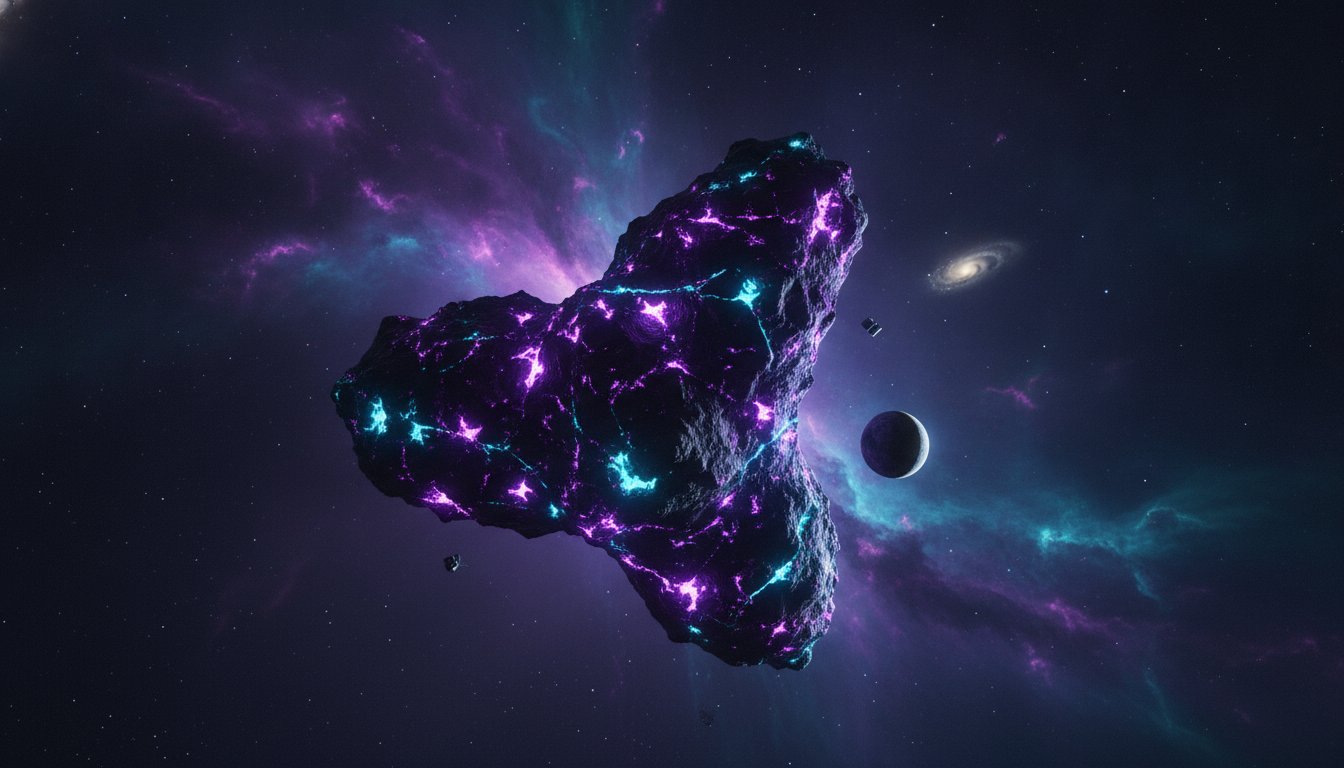
Adding another layer of intrigue, the observations also confirmed the presence of a small moon, designated S/2026 (44) 1, orbiting Nysa at a distance of at least 106 miles (170 km). This moon, a mere 0.6 miles (1 kilometer) wide, was independently observed during two separate campaigns, allowing astronomers to track its motion. Its detection was a feat of astrophotography, as Gianluca Li Causi of the SHARK-VIS team at the Italian National Institute for Astrophysics (INAF) explained, requiring "a specialized technique from another field of astronomy, known as high-contrast imaging, to detect the small moon whose faint light was overwhelmed by the intense brightness of the primary asteroid."
Unraveling Cosmic Origins: Contact Trinary or Cataclysmic Impact?
The formation of such a bizarre object sparks profound questions about the dynamics of the early solar system and the processes that govern these celestial bodies. Minker's team has proposed two primary hypotheses for Nysa's genesis:
- Contact Trinary: The preferred explanation suggests Nysa is a "contact trinary," an assembly of three individual asteroid bodies held loosely together by their mutual gravity. This configuration would represent a rare and stable gravitational ballet.
- Cataclysmic Impact Deformation: Alternatively, Nysa might be the result of a violent past. Researchers posit that a close encounter with a much larger asteroid could have slammed into it, deform its mantle through immense gravitational tidal forces. Such an event could have ripped Nysa apart, potentially creating a "string-of-pearls" configuration of fragments. The challenge with this theory, however, is the apparent lack of a widespread family of similarly composed asteroid fragments that would typically result from such a catastrophic collision.
Distinguishing between these theories hinges on future observations of the moon's orbital velocity and period. By precisely tracking its movements, astronomers can accurately determine Nysa's mass and density, providing critical data to validate one model over the other.
A Window into Earth's Ancient Past
Beyond its peculiar morphology, 44 Nysa holds immense significance for understanding the very origins of our own planet. Nysa is classified as an E-type asteroid, characterized by its highly reflective surface, rich in the iron-poor silicate mineral enstatite. E-type asteroids are believed to have formed closer to the sun, serving as potential building blocks for the inner rocky planets, including Earth, some 4.5 billion years ago. Nysa stands as the largest and brightest known E-type asteroid, making it a prime candidate for studying the conditions and materials present in the inner solar system during its tumultuous formation.
As Al Conrad of the Large Binocular Telescope Observatory fittingly notes, referencing its namesake, the Greek god of theater, Dionysus, often associated with masks: "We're finally unmasking the asteroid's true nature, long after it was discovered." This journey of discovery continues to push the boundaries of our cosmic knowledge, reminding us that even in our well-charted solar system, profound space mysteries and remarkable cosmic phenomena await their grand reveal, offering vital clues to the genesis of worlds. The findings, currently available on the arXiv archive, are awaiting peer-review publication in Astronomy & Astrophysics, promising to reshape our understanding of asteroid evolution and planetary formation.
0 Comments
Login to leave a comment.