The Milky Way, our cosmic home, is a majestic spiral galaxy, a vast collection of billions of stars, gas, and dust swirling around a central supermassive black hole. For eons, astronomers have studied its structure, from its luminous spiral arms to its more diffuse stellar halo. Yet, beneath this seemingly stable façade lies a turbulent past, with recent groundbreaking research suggesting a radical upheaval: our entire galactic disk may have dramatically flipped 90 degrees billions of years ago.
Unraveling a Cosmic Anomaly
Spiral galaxies like the Milky Way typically consist of two primary visible components: a flattened disk containing most of its younger stars, gas, and dust, and a more spherical, diffuse halo of older stars enveloping the disk. While this general structure holds true for our galaxy, the Milky Way's stellar halo has long presented an intriguing anomaly. Observations from the European Space Agency's Gaia mission, which meticulously maps the positions and motions of billions of stars, revealed that the stars within our halo rotate unusually slowly compared to the material within the galactic disk. This peculiar observation became the key to unlocking one of the universe's most profound space mysteries.
Supercomputer Simulations Reveal Galactic Dynamics
To understand this slow-spinning halo, a team of researchers led by Kirill Batrakov of the University of Durham turned to sophisticated supercomputer models. These simulations tracked the evolution of 25 Milky-Way-like galaxies over billions of years, offering a window into the complex cosmic history of galactic formation and interaction. The findings were striking: galaxies that exhibited slowly spinning stellar halos also experienced head-on mergers with other galaxies at some point in their history, or had their main disks flip over.
Batrakov noted, "We already know that the Milky Way had a massive head-on collision in the past with a galaxy known as Gaia-Sausage-Enceladus. So, we think that the Milky Way disk likely flipped in the past."
A Violent Past: The Gaia-Sausage-Enceladus Collision
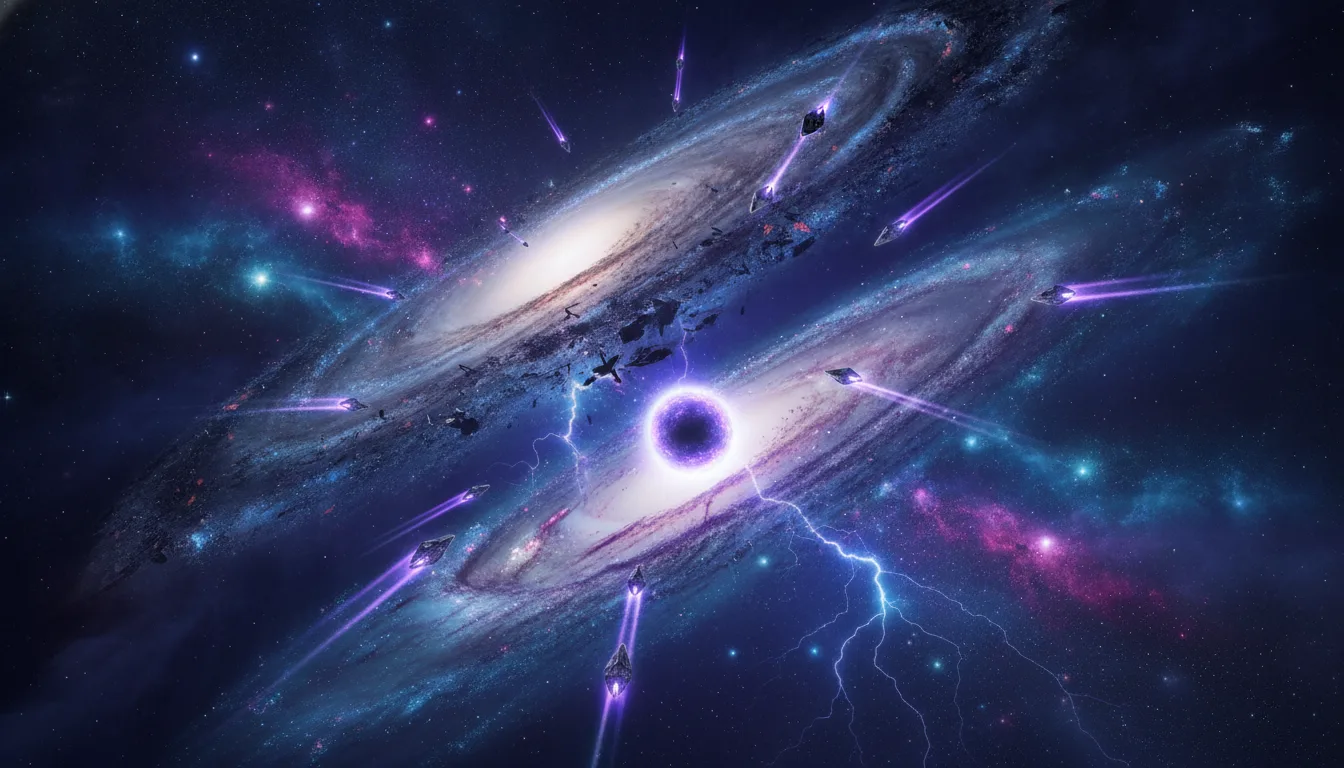
Indeed, the evidence for a monumental galactic merger is compelling. Between 8 billion and 11 billion years ago, a dwarf galaxy named Gaia-Sausage-Enceladus, with a mass exceeding 10 billion times that of our Sun, slammed into the nascent Milky Way. This wasn't a glancing blow but a direct, head-on impact. The collision was so powerful that Gaia-Sausage-Enceladus was ripped apart by the Milky Way's immense gravity. Its stars, gas, and dark matter were channeled onto highly elongated, 'sausage-shaped' streams, which our galaxy gradually incorporated into its own stellar halo. This event, the last major impact our Milky Way experienced, is widely considered a prime candidate for triggering the hypothesized disk flip.
Multiple Mechanisms for Cosmic Upheaval
Interestingly, the simulations also revealed that not all galaxies whose disks flipped had necessarily experienced a head-on merger. "We think that there might possibly be different mechanisms driving the disk flips," Batrakov told Space.com, highlighting the complexity of galactic dynamics. Regardless of the precise cause, both a head-on merger and an independent disk flip contribute to the observed slower rotation of the halo.
In the case of a merger, stars from the colliding galaxy are thrown into the halo on trajectories that are heavily misaligned with the main disk, leading to a collectively slower rotation relative to the disk. Similarly, if the disk itself flips, the halo—due to its larger scale and inertia—doesn't immediately reorient, causing a temporary misalignment and a less coherent, seemingly slower rotation relative to the disk's new orientation.
Implications for Our Cosmic Address and Future Research
Such a dramatic disk flip carries profound implications, even for our own solar system. If this cosmic event occurred during the Sun's lifetime, it means that our solar system's orbit around the galactic center might have been vastly different in the past. "A disk flip means that most of the Milky Way's stars once moved on very different trajectories than they do today, possibly even our sun, meaning our 'stable' spot in the galaxy might not have been so stable for the solar system's whole lifetime," explained Batrakov.
This discovery adds an entirely new chapter to the detailed cosmic history of the Milky Way, reshaping our understanding of galactic evolution. It demonstrates the incredible power of modern astronomy to reconstruct ancient events billions of years after they occurred, purely from present-day observations. As scientists continue to delve into these space mysteries, each new piece of evidence helps to paint a clearer picture of the dynamic universe we inhabit, constantly challenging and expanding our perception of our place within the grand cosmic tapestry.
0 Comments
Login to leave a comment.