
SpaceX's Galactic Pivot: From Rocket Powerhouse to AI Titan with Elon Musk's Vision
SpaceX, the company synonymous with reusable rockets, historic astronaut launches, and ambitious Mars colonization plans, is undergoing a profound metamorphosis. Founder and CEO Elon Musk recently unveiled a staggering strategic shift, declaring that Artificial Intelligence (AI) is rapidly becoming the core of SpaceX's future, with revenue projections reaching an "astronomical" $500 billion annually by 2027. This isn't merely an expansion; it's a redefinition of the company's identity, positioning it as a leading force in the burgeoning AI landscape while still pushing the boundaries of space exploration.
The AI Revolution at SpaceX
Musk’s pronouncement, made during an address to employees on August 11, underscored a dramatic internal transformation. He revealed that AI revenue is set to surpass all other SpaceX income as early as September and will "significantly exceed" it in the fourth quarter. This acceleration is largely fueled by the acquisition of xAI, a startup founded by Musk in 2023. xAI is behind the conversational AI chatbot Grok and operates Colossus, a formidable supercomputer cluster based in Tennessee.
The integration of xAI marks just the beginning of a deep dive into artificial intelligence. Musk articulated a vision where, in four to five years, AI will account for an astounding 99% of SpaceX’s total value. This isn't just about financial metrics; it reflects a fundamental reorientation of the company’s technological and strategic priorities.
Astronomical Ambitions: Powering the Future of AI
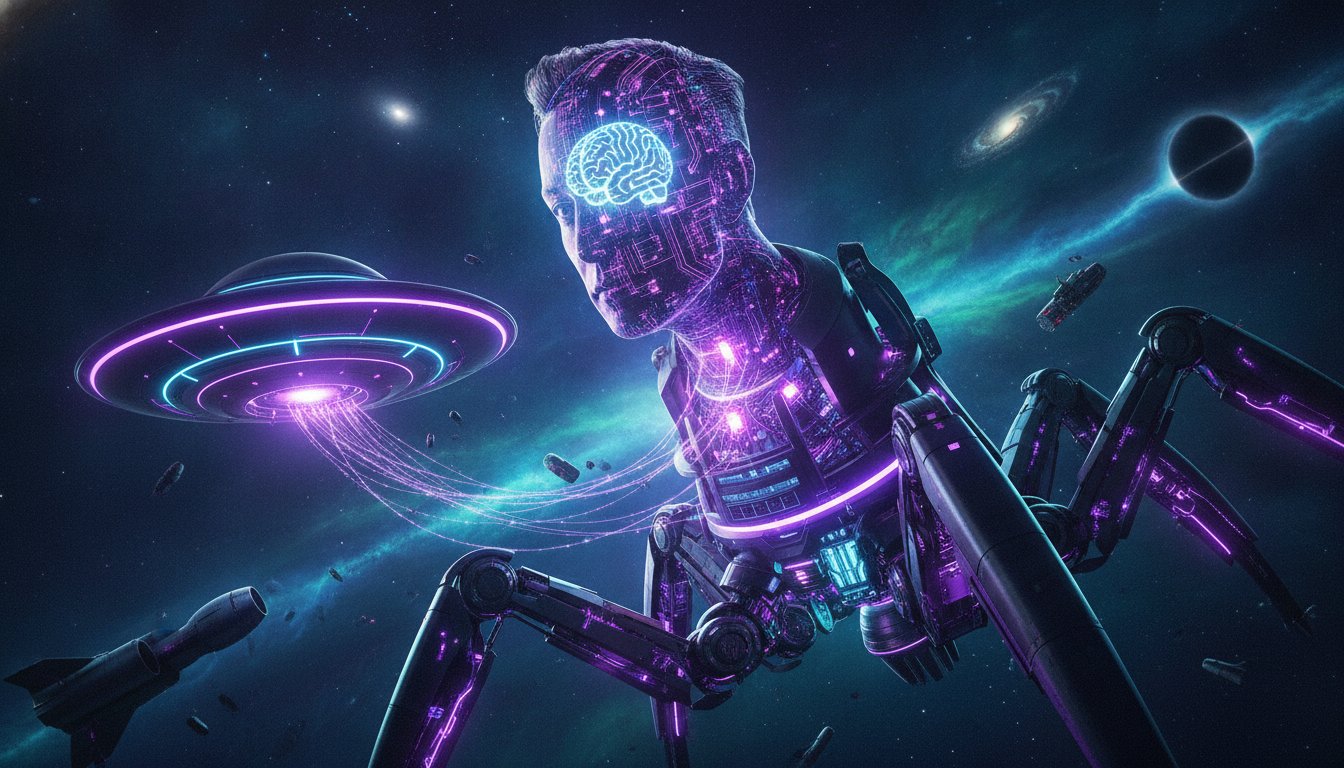
SpaceX isn't just dabbling in AI; it's building the foundational infrastructure for its future. The company aims to bring 10 gigawatts (GW) of AI compute power online by the end of next year, a massive leap from its current 1.4 GW, which is already being sold to tech companies and AI labs. Musk projects that with a value of $30 to $50 per watt, this 10 GW capacity could translate into an annual revenue stream of $300 billion to $500 billion. These "big numbers" are just the beginning, as the company foresees even greater growth.
To achieve these ambitious goals, SpaceX is embarking on several groundbreaking initiatives:
- Terafab Complex: A joint operation with Tesla in Texas, this gigantic complex will manufacture advanced semiconductor chips, critical components for AI processing, across a wide range of applications.
- Starmind AI Satellites: SpaceX plans to launch an unprecedented one million "Starmind" AI satellites into low Earth orbit in the coming years. These satellites, part of an AI megaconstellation, will leverage the fully reusable Starship megarocket, currently under development, for deployment.
- Lunar Data Centers: Looking even further ahead, the company intends to establish factories on the Moon to construct off-Earth data centers. These lunar-based facilities would then launch additional satellites into space using electromagnetic mass drivers, essentially high-powered rail guns, offering a novel method for deploying vast space-based AI infrastructure.
A Trillion-Dollar Market and a Vision for Humanity
The financial implications of this pivot are immense. SpaceX's internal filings, preceding its record-breaking IPO, identified a total addressable market of $28.5 trillion, with nearly $23 trillion of that specifically within the AI field. To put this into perspective, the entire gross domestic product of the United States last year hovered around $30.8 trillion, highlighting the sheer scale of the opportunity SpaceX aims to capture.
Musk emphasized that his motivation extends beyond mere profit. "The future is fundamentally AI and robots," he stated, predicting that "digital intelligence will probably be more than a trillion times the amount of biological intelligence" if civilization continues to advance. He views the development of AI through SpaceX as a crucial endeavor to ensure a beneficial outcome for humanity. "It's important that we have an AI that cares about humanity, that fosters humanity and helps take us to other planets and other star systems," Musk articulated. He believes that an AI "sort of SpaceX's baby" – built by what he considers "some of the very best humans on Earth, both in capability and morality and goodness" – would be a "very good AI."
Beyond Earth: The Ultimate Incentive
For SpaceX employees, the incentive to contribute to this AI-driven future is not just about groundbreaking work; it comes with an extraordinary promise. Musk assured his team that "anyone at SpaceX who wants to go to the moon or Mars will be able to go in the future." This visionary pledge underscores the interconnectedness of SpaceX's AI ambitions with its long-term goal of making humanity a multi-planetary species. The path to the stars, it seems, will be paved not just with rockets, but with artificial intelligence of unprecedented scale and purpose.
0 Comments
Login to leave a comment.