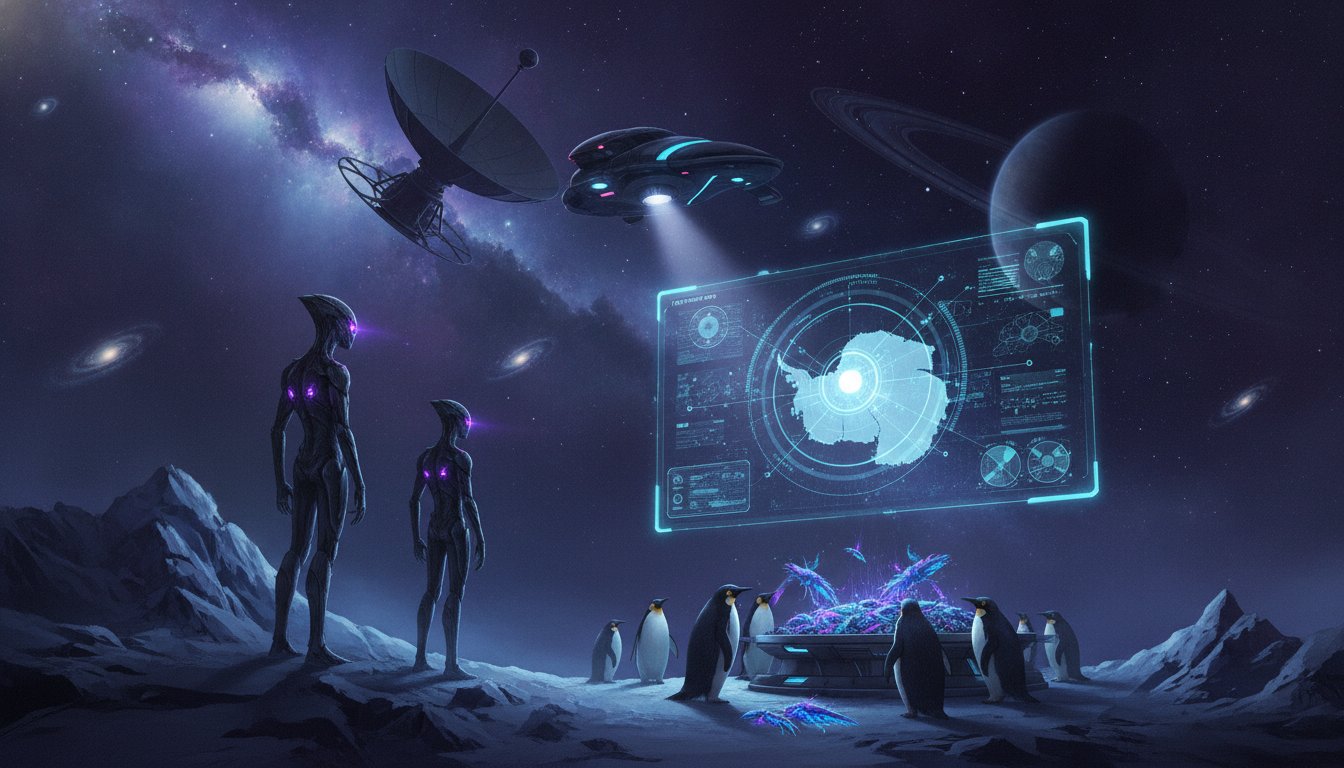
While human curiosity often propels us to search for profound space mysteries beyond our solar system, sometimes the most captivating secrets lie hidden on our own planet, revealed only through the powerful lens of advanced space technology. From hundreds of kilometers above Earth, satellites designed to map distant celestial bodies are now offering unparalleled insights into the intricate dynamics of our terrestrial environment. One such remarkable revelation comes from Antarctica's remote Danger Islands, where a vibrant, almost surreal phenomenon — vast expanses of pink penguin guano — is providing scientists with vital clues about the health of a crucial ecosystem.
The Antarctic Enigma: A View from 700 Kilometers Up
The vast, icy expanse of Antarctica is a realm of extreme beauty and scientific intrigue. Its remote archipelagos, like the Danger Islands, are typically challenging to study in person due to harsh conditions. However, the advent of sophisticated Earth-observing satellites has transformed our ability to monitor these vital regions. On January 22, 2023, the Landsat 8 satellite, a joint mission of NASA and the United States Geological Survey (USGS), captured an image that unveiled a striking visual anomaly: large sections of Heroína Island and Beagle Island, part of the Danger Islands, were stained a distinct pinkish-orange. This vibrant coloration was not a geological feature but rather the unmistakable signature of Adélie penguin guano, offering a direct, visible link to the birds' diets and, by extension, the health of their marine habitat.
Adélie Penguins: Sentinels of the South
Adélie penguins (Pygoscelis adeliae) are charismatic inhabitants of the Antarctic continent, playing a critical role in the polar food web. These hardy birds primarily feed on krill (Euphausia superba), small, shrimp-like marine crustaceans that form the base of the Antarctic ecosystem. Krill themselves consume a specific type of algae that gives them their characteristic bright pink color. Consequently, when Adélie penguins consume large quantities of krill, their droppings, or guano, take on this same vibrant pink hue. This biological chain of events creates a unique ecological indicator that, incredibly, can be observed from space.
Landsat 8: Eyes in the Sky
The ability to track changes in penguin diets from 438 miles (705 kilometers) above Earth's surface is a testament to the remarkable capabilities of modern satellite technology. Landsat 8's operational land imager and thermal infrared sensor are designed to monitor Earth's surface across various spectral bands, making it ideal for detecting subtle environmental changes. The bright pink color of the krill-rich guano stands out sharply against the icy, white, and rocky landscape in satellite imagery, allowing researchers to accurately map the extent of penguin colonies and infer their dietary habits without needing to set foot on the ground initially. This remote sensing technique is revolutionary for studying hard-to-reach populations.
From Guano to Global Insights
While satellite imagery provides an invaluable broad-scale view, scientists often seek more granular data. The Landsat-8 data allowed researchers to pinpoint potential penguin colony locations, guiding subsequent expeditions equipped with drones. As seen in images captured during a research expedition, drones provided closer, high-resolution views of the Adélie penguin colonies, enabling detailed behavioral observations and, crucially, the collection of guano samples directly from the ground. Analyzing these samples revealed concrete evidence of what the penguins had been eating over time, correlating directly with the satellite-observed color changes. This multi-layered approach, combining orbital, aerial, and ground-level data, offers a comprehensive understanding.
Why This Matters: Climate Change and the Food Web
The primary motivation behind monitoring Adélie penguin diets is far-reaching. According to a NASA statement, researchers are using these combined satellite images and samples to track how the penguins' diet might be affected by changes in sea ice conditions. Dr. Casey Youngflesh, a biologist at Clemson University who led a study comparing penguin diet and sea ice, emphasized the profound link: "Sea ice is such a hugely important factor in the Antarctic marine environment. The structure of the region's food web is changing in response." Variations in sea ice directly impact krill populations, which are fundamental to the survival of penguins, seals, and whales. By monitoring the 'pink poop' from space, scientists gain a real-time, large-scale indicator of ecosystem health, helping them to understand and predict the cascading effects of climate change on one of Earth's most pristine yet vulnerable environments. This advanced ecological monitoring from space is not just about penguins; it's about understanding the delicate balance of our planet's future.
![[EN] 'Strange New Worlds'' latest episode is more 'Event Horizon' than classic Trek](/uploads/-strange-new-worlds-latest-episode-is-more-event-horizon-than-classic-trek--cover-1785416515164.jpg)

0 Comments
Login to leave a comment.