A Deliberate Collision: A New Era of Lunar Science
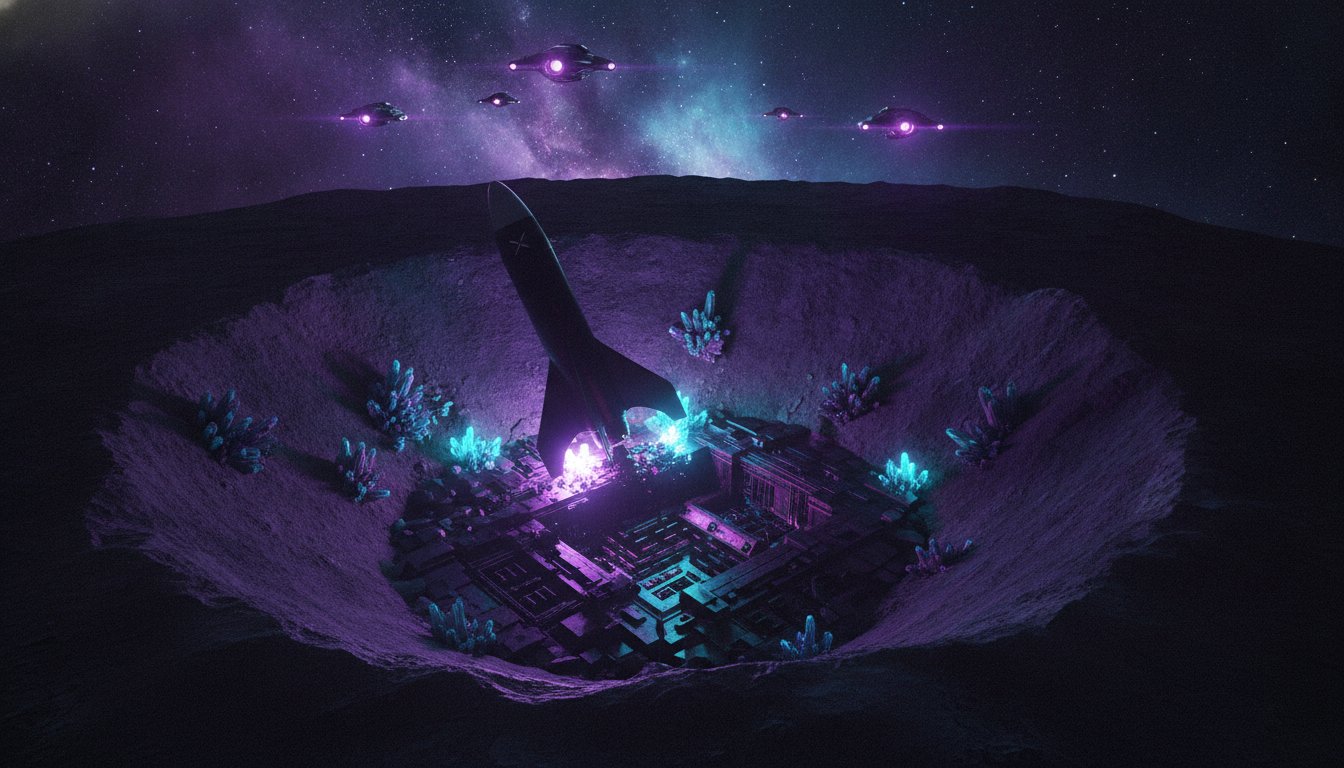
On August 5th, a unique event will unfold in our celestial neighborhood: a spent SpaceX Falcon 9 upper stage, a remnant from a prior lunar mission, is slated for a high-speed collision with the Moon. Far from an accidental mishap, this intentional impact presents an extraordinary and rare 'slam-dunk science' opportunity for researchers worldwide. This precise targeting of a known object allows for unparalleled observation and data collection, transforming what might otherwise be space debris into a powerful scientific tool.
The Object and Its Origin
The Falcon 9 upper stage, now an errant piece of space hardware, is a leftover from the January 15, 2025, launch that propelled Firefly's Blue Ghost-1 lander towards the Moon. The same mission also carried the Hakuto-R Mission 2, dubbed Resilience, a robotic lunar lander developed by the Japanese company ispace. Its impending impact near the Einstein and Bell craters, situated near the western lunar limb, has captured the attention of astronomers and lunar scientists alike, promising insights into the fundamental physics of celestial impacts.
Predicting the Spectacle: Visible Plumes and Scientific Promise
An international team, whose findings were recently published on the open-source arXiv server, has utilized advanced physics simulations to model the impending event. William Jo, a graduate research assistant at the University of Texas, Austin, and his colleagues predict a debris plume with a central ejecta spike reaching an astounding 47 to over 60 miles (75 to 100 kilometers) in altitude. More remarkably, their calculations suggest that for the first few minutes post-impact, this plume could be several orders of magnitude brighter than the dark lunar sky, potentially making it visible to keen moongazers equipped with sufficiently sensitive telescopes.
Jo emphasizes that while precise visibility can vary, the core scientific value lies beyond the initial flash. "Watching this one gives us a rare chance to open up ejecta-plume science and calibrate those models against a real event, which matters for every future thing we deliver to the moon," Jo explained to Space.com. This calibration is critical for understanding lunar surface dynamics and the behavior of material under extreme conditions.
Implications for Future Lunar Exploration and Safety
Beyond the immediate spectacle, the scientific implications of this impact are profound. New research led by Benjamin Fernando of the Los Alamos National Laboratory highlights that the impact flash and subsequent ejecta plume are "potentially observable" by both ground- and space-based facilities. This unique event provides a real-time opportunity to test sophisticated localization pipelines for future seismic experiments on the lunar surface. By analyzing the dust and plume dynamics, scientists can gain critical insights into how impacts affect the lunar environment.
Furthermore, this deliberate collision offers a chance to assess hazards posed by artificial space debris impacts, which future astronauts and lunar infrastructure might encounter. Fernando's team notes, "The maximum ballistic range of resolved particles is found to be slightly under 1,000 km, which is far enough to be significant from the perspective of presenting a hazard to future astronauts or infrastructure across much of the lunar surface." Understanding these potential risks is paramount as humanity plans a return to and sustained presence on the Moon.
NASA's Lunar Reconnaissance Orbiter (LRO), under the guidance of project scientist Brent Garry, will play a crucial role. LRO is scheduled to pass over the impact site approximately seven days before and seven days after the event, providing invaluable "before and after" imagery and data to precisely locate and characterize the new crater and its surrounding ejecta.
The Uniqueness of Human-Made Impacts
William Jo further underscores a critical scientific distinction: spent rocket stages, being hollow and spacecraft-like, produce vastly different plumes compared to natural impactors like asteroids or comets. Existing impact models are largely based on natural phenomena, making this controlled experiment with a human-made object particularly valuable. It offers a unique opportunity to refine our understanding of how artificial structures behave upon high-velocity impact with a celestial body.
For those observing, Jo stresses the importance of tracking the ejecta, not just the fleeting initial flash. The true scientific contributions, he notes, will come from studying the moments following the impact as the debris plume evolves. This event, while seemingly a straightforward collision, represents a sophisticated endeavor into the mysteries of space, offering unparalleled insights into lunar geology, impact physics, and the safety of our future in cosmic exploration.




0 Comments
Login to leave a comment.