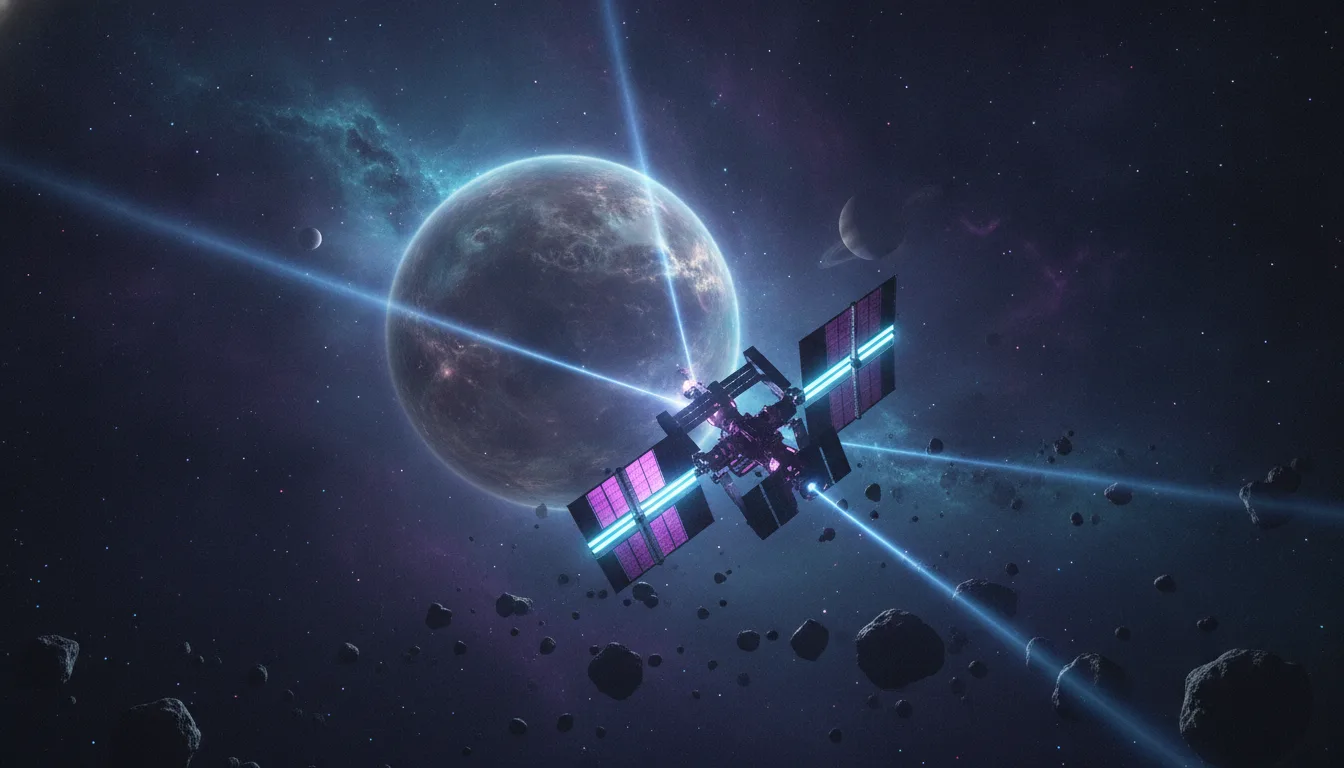
A Dazzling Cosmic Alignment: Capturing the Elusive in Daylight
In an extraordinary display of skill and meticulous planning, astrophotographer A.J. Smadi has once again captivated the space community with a stunning image: the International Space Station (ISS) seemingly in alignment with the planet Venus, all captured during the bright light of day. This incredible photograph, taken on July 18, 2026, from Edmonds, Washington, near Seattle, stands as a testament to the cutting-edge capabilities of modern astrophotography and the unwavering dedication of those who explore the cosmos through their lenses.
The Astrophotographer's Quest for the Unseen
A.J. Smadi is no stranger to pushing the boundaries of celestial photography. Over a year prior, his work, which also featured the ISS alongside Venus, garnered recognition from NASA as one of its Astronomy Photos of the Day. This latest achievement, however, was driven by a powerful personal challenge. "The thing that inspired me to capture Venus with the ISS is the fact that nobody has done it before," Smadi revealed. "After having realized this in April 2025 following my first time capturing the pair together, I was determined to best my own achievement."
His methodology involves specialized equipment and a deep understanding of atmospheric conditions. For this particular shot, Smadi utilized a 9.25-inch (23.5 cm) Celestron Schmidt-Cassegrain Telescope, renowned for its optical precision, paired with a ZWO ASI662MC camera. Crucially, the setup included an ultraviolet and infrared filter, essential for isolating and enhancing the subtle light of the celestial objects against the overwhelming brilliance of the daytime sky. This combination allows for details often lost to the naked eye, revealing a hidden dimension of space mysteries right above us.
The Astronomical Challenge: Speed, Distance, and Daylight
The sheer complexity of this photograph cannot be overstated. Capturing objects like Venus or the ISS in daylight, aside from the moon, requires a mastery of technique that goes far beyond typical nighttime astrophotography. The sky itself becomes a powerful diffuser, making faint celestial bodies almost invisible. But the challenge extends far beyond mere visibility:
- Blinding Speed: The ISS hurtles through Earth's orbit at an astonishing 4.6 miles per second (7.5 km per second). This means it traverses the sky at an incredible pace, allowing only a fleeting window for photography.
- Vast Distance: While the ISS is relatively close in Earth's orbit, Venus is an astounding 84 million miles (135 million kilometers) away. To capture both in a single frame, appearing as if in close proximity, demands immaculate alignment and precise timing.
- Atmospheric Instability: Smadi himself notes that the clarity of his ISS photographs varies greatly depending on the stability of the air and the station's distance from his location. Atmospheric turbulence can distort images, making sharp captures even more difficult.
Lining up these two immensely different cosmic elements—a man-made marvel orbiting Earth and a distant planet—requires painstaking planning, meticulous calculation, and an intuitive understanding of celestial mechanics. It's a delicate dance between predicting trajectories, managing optical equipment, and battling the elements.
Revealing the Wonders of Our Sky
Smadi's work is a powerful reminder that our skies are perpetually dynamic, filled with incredible phenomena that await discovery through the right lens and persistent vision. His Instagram feed showcases a portfolio of breathtaking images, including the ISS transiting the sun and the moon, and even passing by Saturn. Each image not only demonstrates technical brilliance but also inspires a renewed sense of wonder about our place in the universe.
These daylight ISS sightings and planetary conjunctions, meticulously captured, transform the invisible into the visible, drawing attention to the cosmic ballet happening constantly above our heads. Smadi's dedication serves as an inspiration for aspiring astrophotographers and a testament to the endless beauty and space mysteries that can be uncovered with passion and precision. Through such efforts, we gain a clearer, more profound appreciation for the intricate workings of our solar system and the celestial wonders that populate it.
0 Comments
Login to leave a comment.