The Enduring Enigma of Majestic 12: Deciphering the Truth Behind UFO Disclosures
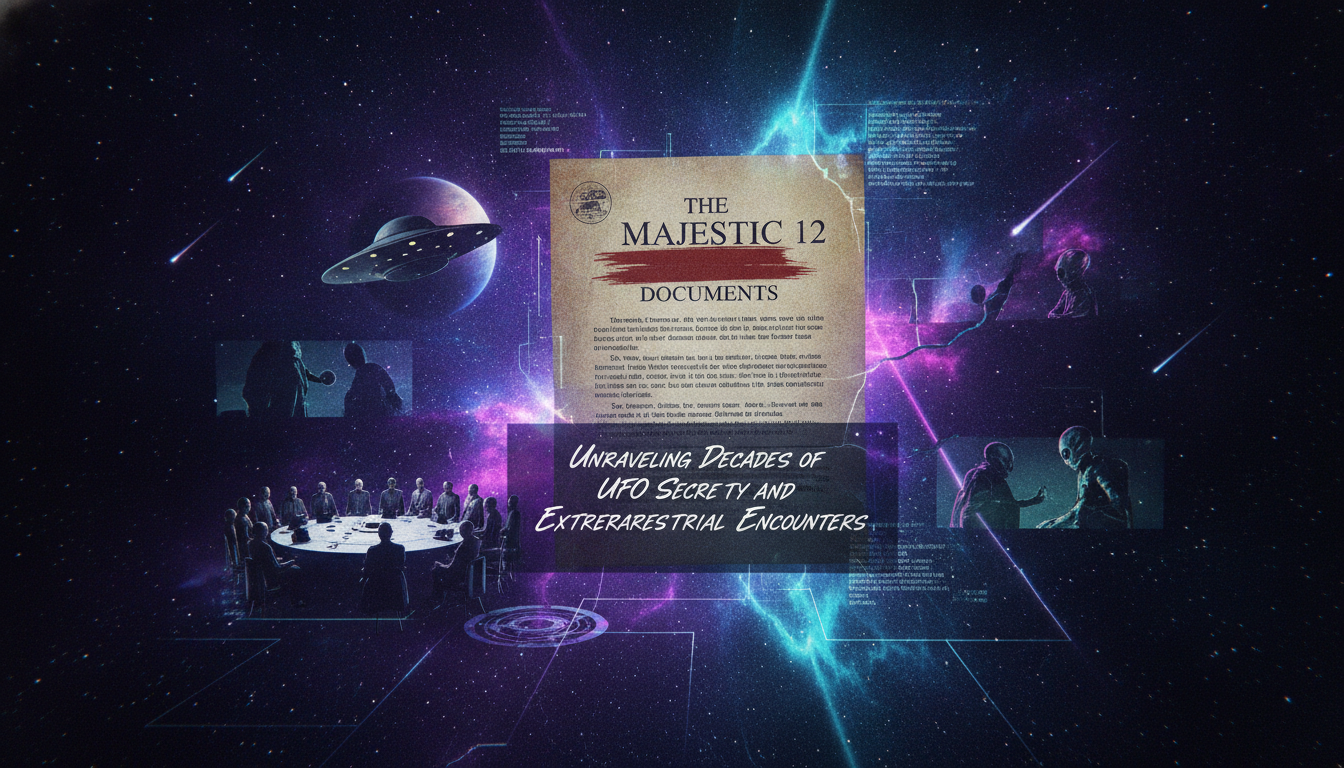
The purported existence of the Majestic 12 (MJ-12) documents has long been a lightning rod in the contentious world of ufology. These highly classified papers allegedly chronicle a clandestine U.S. government committee formed in 1947, tasked with recovering, studying, and concealing evidence of crashed extraterrestrial spacecraft and their occupants. If authentic, these documents—principally the Eisenhower Briefing Document (EBD) of November 18, 1952, the Truman-Forrestal Memo (TFM) of September 24, 1947, and the Cutler-Twining Memo (CTM) of July 14, 1954—unveil a truth of monumental proportions: humanity is not alone, and governments have actively orchestrated a profound cover-up of 'extraterrestrial races' visiting our planet for decades, fundamentally altering our perception of 'space mysteries'.
Unveiling the Controversial Legacy: Stanton Friedman's Tireless Research
The controversy surrounding MJ-12 began in 1984 when a roll of exposed 35mm film was anonymously delivered to Jaime Shandera, leading to extensive collaborative investigations with William Moore and, crucially, nuclear physicist and renowned ufologist Stanton T. Friedman. Their work brought the EBD, TFM, and CTM into the public domain. Later, other documents surfaced, including the SOM 1-01 (Special Operations Manual: 'Extraterrestrial Entities and Technology, Recovery and Disposal') received by Don Berliner, and a deluge of additional, often difficult-to-read, papers received by researcher Tim Cooper. Friedman’s life’s work became a steadfast defense of the core documents’ authenticity, meticulously countering every challenge with painstaking research and archival evidence.
The Battleground of Authenticity: Debunkers vs. Evidence
Friedman categorized the opposition into several groups, ranging from those who simply deny the possibility of alien visitation outright, to former military personnel citing anachronistic formats, and armchair theorists making judgments without due diligence. Common arguments against the documents included a perceived lack of proper security markings, incorrect military ranks, and the incredulity of including a well-known UFO skeptic like Dr. Donald Menzel on such a covert committee.
The "Absence of Evidence" Fallacy: Classified Documents and Protocols
Critics often cited the absence of TOP SECRET control numbers on the MJ-12 documents as proof of fraud. Friedman meticulously demonstrated this claim was baseless. Archivists at the Eisenhower Library confirmed that numerous TOP SECRET documents from that era lacked control numbers, especially those originating from the White House. Furthermore, the distinctive