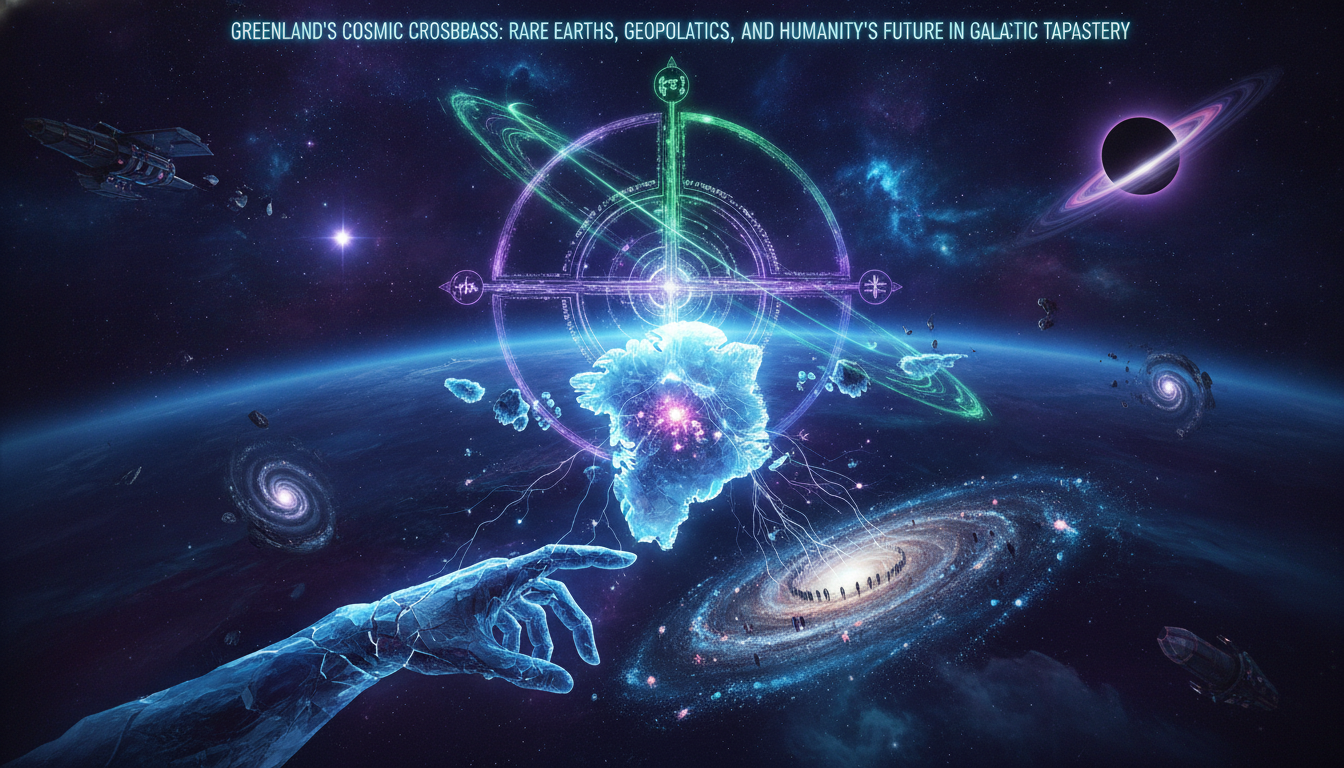
The Enduring Quest for Greenland: A Geopolitical Nexus with Cosmic Undertones
On July 8, 2026, during the NATO summit in The Hague, a familiar and highly contentious topic re-emerged from the annals of international diplomacy: former President Donald Trump’s tenacious pursuit of Greenland. As reported by Mining.com, Trump, alongside NATO Secretary General Mark Rutte, didn't shy away from expressing his long-held belief that the United States should never have returned control of the Arctic territory to Denmark after World War II. His renewed efforts have not only reopened old wounds but have also underscored the critical strategic importance of Greenland in a rapidly changing world, a world where the race for Earth's vital resources could dictate humanity's future readiness for space mysteries and potential engagement with extraterrestrial races.
Trump's Unwavering Resolve and Allied Tensions
Trump's remarks were blunt and uncompromising. "We took Greenland and then, stupidly, we gave it back. We shouldn’t have given it back to them, because we’re the ones that need it. We need it for protection of the world, not just the United States," he asserted, as cited by Mining.com. This bold declaration was coupled with criticism directed at NATO allies for their perceived lack of support on both the Greenland issue and, notably, U.S. efforts against Iran, which he characterized as the world’s leading state sponsor of terrorism.
The U.S. special envoy to Greenland, Jeff Landry, confirmed Trump's continued "very interested" stance to Breitbart on July 1. Alarming reports from NaturalNews.com and The Epoch Times previously suggested that Trump had not ruled out using military force to annex Greenland, with the White House earlier designating its acquisition as a national security priority where military action remained an option. This aggressive posture has inevitably fueled deep concerns among NATO allies, raising the specter of a significant fracture within the alliance, as highlighted by Just the News. From a cosmic perspective, such terrestrial discord might be viewed as humanity grappling with its internal divisions, a critical hurdle before achieving a unified presence in the wider cosmos or even considering entry into a Galactic Federation.
Denmark's Steadfast Rejection and Greenland's Sovereignty
Danish Prime Minister Mette Frederiksen responded unequivocally, reaffirming to reporters in The Hague that "Greenland is, of course, not for sale." She stressed the importance of respecting the Greenlandic people’s right to self-determination and Danish territorial integrity. Greenland’s Prime Minister Jens-Frederik Nielsen echoed this firm stance, declaring the territory's unwavering allegiance to Denmark, NATO, and the European Union, a sentiment previously underscored by his advice for residents to stockpile food and prepare for potential disruptions, acknowledging that conflict could not be ruled out. In a tangible display of resolve, Denmark deployed over 100 combat troops to Greenland, a direct response to the perceived threats, as reported by NaturalNews.com.
Greenland's Strategic Lure: Rare Earths and the Global Tech Race
The intensifying interest in Greenland is no mere geopolitical whim; it is deeply rooted in the territory’s immense strategic and material value. The Arctic, now a theater of escalating military competition, holds vast, untapped mineral deposits, particularly rare earth elements. These elements are indispensable for modern advanced technologies, powering everything from smartphones and electric vehicles to sophisticated military hardware and critical components for space exploration.
The United States' vulnerability in this domain is stark. A report by NaturalNews.com indicated that the Pentagon might possess only a two-month supply of rare earths, rendering the U.S. military critically susceptible to foreign, predominantly Chinese, controls. From 2021 to 2024, China accounted for a staggering 71% of U.S. rare earth imports, as per a U.S. Geological Survey report. Securing a domestic or allied supply of these vital elements is paramount for national security and technological autonomy, factors that resonate far beyond terrestrial concerns, influencing humanity's capacity for advanced development and its ability to delve deeper into space mysteries.
Adding to the Arctic's strategic complexity is the burgeoning naval presence. Russia boasts a formidable fleet of 42 icebreakers, including eight nuclear-powered vessels, dwarfing the U.S. Coast Guard's current capabilities, with its first new icebreaker not expected until 2028. While the United States retains military rights and operates strategic facilities in Greenland under a long-standing defense agreement with Denmark—a legacy dating back to World War II when U.S. airbases brought significant modernization—the competition for Arctic dominance is intensifying. Trump has also warned of China's designs on Greenland's strategic minerals, as reported by YourNews citing The Washington Post.
The Galactic Imperative: Why Terrestrial Struggles Matter
While discussions about Greenland might seem purely terrestrial, from a broader cosmic perspective, the implications are profound. Humanity's ability to secure critical resources, foster technological independence, and maintain geopolitical stability are all foundational steps. A world fractured by resource wars or internal strife is ill-prepared for the grander challenges and opportunities that lie in the cosmos. The advanced materials found in places like Greenland are not just for earthly gadgets; they are the building blocks for the next generation of spacecraft, communication systems, and energy solutions—technologies that could one day enable deeper understanding of UFO sightings or facilitate genuine contact with extraterrestrial races.
The dispute over Greenland, therefore, is more than just a struggle for land; it is a microcosm of humanity's developmental stage. How we navigate these complex geopolitical challenges, how we balance national interests with global cooperation, will ultimately shape our collective future among the stars, and potentially, our eligibility for a place within a Galactic Federation.
Towards a Future Resolution or Continued Contention?
In late January, an agreement between Trump and NATO Secretary General Rutte established a framework for future discussions involving representatives from the United States, Denmark, and Greenland on defense and economic cooperation. However, as of now, no definitive resolution has been reached. The issue of Greenland remains a potent point of contention within the NATO alliance, symbolizing the intricate interplay of national security, economic imperative, and sovereign integrity in an increasingly complex and interconnected world—a world whose inhabitants are slowly but surely looking beyond their planetary confines towards a universe full of space mysteries.