An Unprecedented Encounter in Alaskan Skies
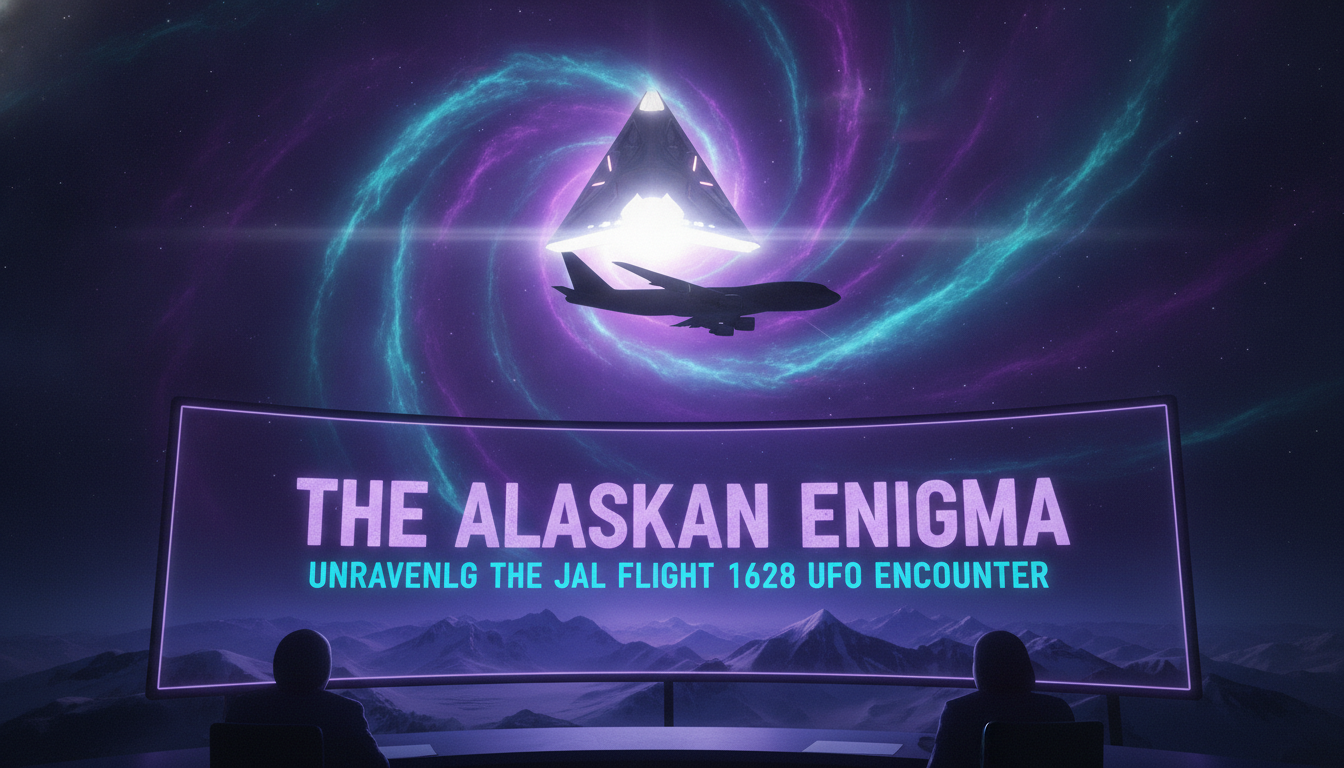
The vast, often desolate skies above Alaska have long been a canvas for natural wonders, but on a crisp November evening in 1986, they bore witness to an event that transcended the ordinary and plunged into the realm of the unexplained. Japan Air Lines (JAL) Flight 1628, a Boeing 747 cargo freighter en route from Reykjavík to Anchorage, was navigating the darkening Alaskan interior at 35,000 feet. Aboard were Captain Kenju Terauchi, an ex-fighter pilot with 29 years of experience, First Officer Takanori Tamefuji, and Flight Engineer Yoshio Tsukuba. What began as a routine cargo run, laden with Beaujolais wine, would soon morph into one of the most astonishing UFO sightings ever recorded, prompting official investigations and fueling decades of debate over extraterrestrial races and advanced aerial technologies.
At approximately 5:19 PM Alaska Standard Time, Captain Terauchi first observed unusual lights to his port side, lights that defied all conventional understanding. Anchorage Air Route Traffic Control Center (ARTCC) confirmed no other known aircraft in the vicinity, yet the lights persisted. Within minutes, these distant luminosities escalated into a close-range spectacle, registering not only visually but also on JAL 1628’s onboard weather radar. Elmendorf Air Force Base Regional Operations Control Center (ROCC) briefly corroborated a "primary" (non-transponding) target near the 747, a fleeting confirmation that added a layer of intrigue to the pilot's vivid reports.
The "Mothership" and a Desperate Dance
The encounter intensified dramatically. Captain Terauchi vividly described two smaller, highly agile objects, often described as having rectangular clusters of glowing nozzles, darting around his jumbo jet. These objects exhibited instantaneous acceleration and emitted blinding white, orange, green, and amber lights, so intense they lit up the cockpit and even radiated palpable heat. Terauchi firmly distinguished them from stars or planets, emphasizing their purposeful, controlled movements. His detailed sketches, later submitted to the FAA, depicted these smaller craft with an undeniable sense of structure and intelligent behavior.
The climax of the event arrived when these initial objects departed, only for a much larger, darker presence to emerge. Captain Terauchi gazed upon a colossal silhouette, which he famously estimated to be "two times bigger than an aircraft carrier." He described it as resembling a "walnut" or a Saturn-like shape, with a bulging center and a thick ring, devoid of conventional wings or tails. This gargantuan "mothership" maintained pace with JAL 1628, prompting the crew to request evasive maneuvers, including descents and a full 360-degree turn. Throughout these actions, the immense object mirrored the 747's movements, cementing its active and deliberate nature. Despite attempts by Anchorage Center to confirm the visual with a United Airlines flight and a USAF tanker, neither could spot the mysterious objects, leaving JAL 1628's crew as the sole visual witnesses.
A Battle for Transparency: FOIA and Rediscovered Records
The JAL 1628 incident quickly became a symbol of the government's often-opaque approach to unidentified aerial phenomena. Initially, the FAA and military were tight-lipped, but Captain Terauchi's decision to share his account with Japanese reporters in late 1986 ignited a media firestorm. The FAA's Alaska region public affairs officer, Paul Steucke, unusually confirmed that something had indeed been tracked on radar, lending immediate credibility to the sensational claims.
What followed was a protracted struggle for official documentation. For years, the FAA claimed records related to JAL 1628 had been destroyed. However, tenacious efforts by researcher John Greenewald Jr. of The Black Vault, initiated with a FOIA request in 2001, eventually led to a stunning discovery in 2018. Instead of the claimed 107 pages, Greenewald located over 1,500 pages of material in the National Archives, including radar data, transcripts, pilot interviews, and internal FAA communications. This remarkable rediscovery transformed JAL 1628 into one of the most extensively documented UFO sightings in aviation history, providing a treasure trove for those seeking answers to space mysteries.
Skepticism and Enduring Questions
Despite the wealth of documentation, definitive answers remain elusive, fueling the ongoing debate between believers and skeptics. Skeptical arguments, championed by figures like aerospace journalist Philip J. Klass, propose prosaic explanations:
- Radar Anomalies: The intermittent radar blips, Klass argued, could be attributed to a "split radar image" or "uncorrected primary return"—a technical glitch where radar momentarily creates a duplicate echo of a single aircraft.
- Pilot Misidentification: Klass suggested that the bright lights might have been misidentified celestial bodies, specifically the exceptionally bright planet Jupiter, which was in the southern sky precisely where Terauchi first reported the UFO. Mars was also nearby.
- Pilot Bias: Captain Terauchi's previous two UFO sightings led Klass to label him a "UFO repeater," implying a predisposition to interpret ambiguous phenomena as extraterrestrial.
Yet, counter-arguments persist. Radar analysts like Dr. Bruce Maccabee contend that the data suggests a genuine unknown target. The JAL crew vehemently denied misidentifying planets, insisting on the objects' purposeful motion and structure. The temporary grounding of Captain Terauchi by Japan Air Lines further highlighted the professional repercussions faced by pilots reporting such incidents, a stigma now being challenged in the context of renewed government interest in UAP.
Legacy and the Quest for Understanding
The JAL Flight 1628 incident remains a cornerstone of unidentified aerial phenomena research. Its legacy is multifaceted: it stands as a testament to the credibility of seasoned pilots, highlights the bureaucratic challenges in investigating such events, and continues to provoke thought on the potential for advanced, unknown craft in our airspace.
In an era of increasing transparency regarding UAP, historical cases like JAL 1628 are being re-examined. The sheer volume of retrieved documentation, coupled with the consistent testimonies of highly trained professionals, compels us to consider the possibility that some space mysteries defy conventional explanation. Whether it was an optical illusion, a radar glitch, or a genuine encounter with an unknown intelligence, JAL 1628 forces us to confront the profound questions that linger in the vastness above. It calls for an open mind and rigorous scientific inquiry, fostering an environment where pilots can report what they see without fear, paving the way for a deeper understanding of the phenomena sharing our skies.