The Tehran 1976 UFO Incident: Unraveling a Benchmark Military Encounter
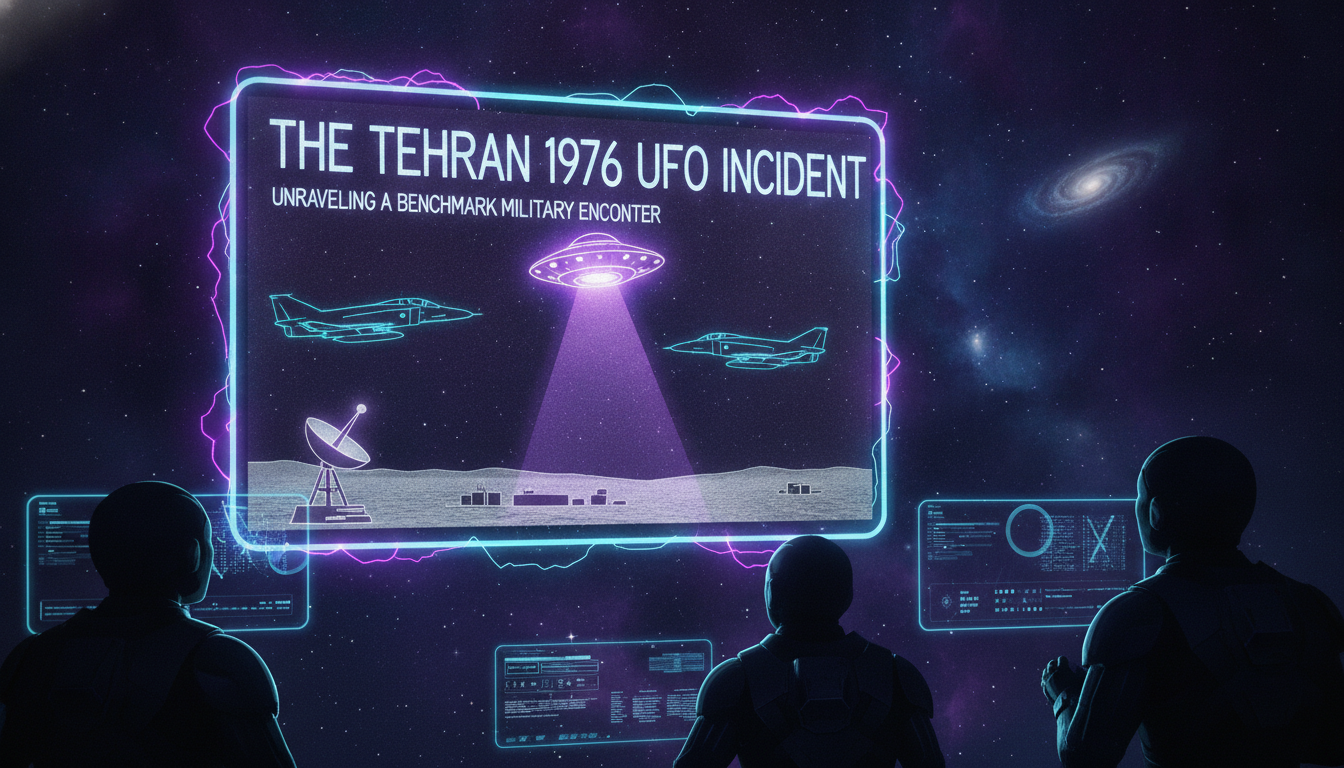
Among the most compelling and meticulously documented UFO sightings in history, the 1976 Tehran incident stands out. In the early hours of September 19, 1976, what began as civilian reports of a strange light escalated into a high-stakes aerial encounter involving Imperial Iranian Air Force F-4 Phantom II jets. This event, supported by declassified U.S. intelligence reports and consistent witness testimonies, continues to be a pivotal case for those exploring space mysteries and the potential for extraterrestrial races.
A Night of Intercepts and Unexplained Phenomena
The incident commenced late on September 18, 1976, when Iranian citizens reported an unusually bright, hovering object over Tehran. General Nader Yousefi, the IIAF's deputy commander of operations, initially skeptical, became convinced after observing the intensely luminous object himself. He promptly ordered an F-4 Phantom II to investigate.
First F-4: A Sudden Systems Shutdown
At approximately 1:30 a.m., Lieutenant Yaddi Nazeri piloted the first F-4. As he neared the brilliant object, his jet experienced a complete and sudden electrical failure, losing all instrumentation and communications. Forced to abort the intercept, Nazeri reported that his systems mysteriously restored themselves the moment he turned away from the UFO.
Second F-4: Radar Lock, Chasing Lights, and a "Missile-like" Object
Ten minutes later, Major Parviz Jafari, accompanied by weapons officer Lt. Jalal Damirian, launched in a second F-4. Damirian quickly obtained a radar lock on the object at 27 nautical miles, describing a massive return akin to a Boeing 707. Jafari visually described the UFO as an intense, rapidly strobing array of red, green, orange, and blue lights. The object displayed "inordinate maneuverability," effortlessly matching the F-4's speed and maintaining a constant distance.
The encounter escalated when a smaller, highly luminous object reportedly "emerged out of the original object" and sped directly toward Jafari's F-4. As Jafari attempted to fire an AIM-9 Sidewinder missile, his weapons control panel and communications simultaneously failed. After evasive maneuvers, the smaller object then executed a precise "re-docking" with the primary UFO, and Jafari's systems instantly returned online.
Mysterious Descent and Further Anomalies
Jafari's crew then observed another object descend rapidly from the main UFO, appearing to land gently in a dry lake bed near Karaj, emitting a brilliant glow. Later, during the F-4's landing approach to Mehrabad, both Jafari's jet and a civilian airliner experienced intermittent radio interference and system fluctuations. A third, distinct cylindrical object was also sighted by Jafari's crew and visually confirmed by Mehrabad tower controllers.
Official Validation: A "Classic" UFO Case
The Tehran incident's credibility is significantly bolstered by declassified U.S. Defense Intelligence Agency (DIA) reports. These detailed documents were widely distributed to high-level U.S. agencies, including the White House, CIA, and NSA. A DIA analyst's evaluation famously deemed the report "outstanding" and a "classic which meets all the criteria necessary for a valid study of the UFO phenomenon." This included multiple credible witnesses (General Yousefi, experienced pilots and controllers), visual and radar confirmation, significant electromagnetic effects on aircraft, and the UFO's unparalleled maneuverability. Such an endorsement from a major intelligence agency is rare, cementing its status as a top-tier UFO sighting.
Compelling Testimonies and Skeptical Scrutiny
The consistent accounts of multiple witnesses—from the initial civilian callers to General Yousefi, the two F-4 aircrews (Maj. Jafari becoming a vocal advocate for the unknown), ground controllers, and even locals near the landing site—paint a coherent picture of a highly unusual event. Jafari himself later speculated the object was "not from Earth," indicating a conviction in its non-terrestrial origin.
Naturally, the case has faced rigorous skeptical scrutiny. Hypotheses include astronomical misidentification (the planet Jupiter), coincidental equipment malfunctions (one F-4 had a history of electrical issues), pilot fatigue leading to misperceptions (especially given meteor showers that night), and the discovery of an unrelated military transponder near the alleged landing site. While these arguments offer plausible explanations for individual elements, they struggle to coherently account for the totality: the sequential, synchronized system failures across two different jets, the radar tracking, and the object's sophisticated, coordinated maneuvers. For many, the sheer improbability of such a confluence of mundane events occurring simultaneously remains a powerful counter-argument.
Enduring Questions and Lasting Impact
Despite extensive analysis, core questions about the Tehran incident persist: What was the primary object? What technology caused the targeted electronic failures? What was the "missile-like" secondary object? What genuinely landed and emitted a glow without leaving a trace? Crucially, why have radar recordings or alleged U.S. DSP satellite infrared data never been publicly released, and why did subsequent official follow-up reports seemingly vanish? These profound space mysteries ensure the case remains an open puzzle.
The Tehran incident's legacy is immense. It became a "benchmark" case in ufology, influencing researchers and implicitly shaping defense thinking on unexplained aerial phenomena. Major Jafari's public testimony lent significant credibility, and the incident even inspired John Greenewald Jr.'s pioneering FOIA work with The Black Vault, championing government transparency on UFO sightings. It continues to challenge conventional explanations, urging continued, open-minded inquiry into what truly transpired over Iran on that unforgettable night.
Conclusion: A Cosmic Puzzle Demanding Answers
The 1976 Tehran UFO incident is a fascinating and unresolved chapter in the history of space mysteries. It presents a compelling blend of credible military testimony, official documentation, and technological anomalies that defy easy explanation. While skeptical viewpoints highlight potential mundane factors, the case's cohesive narrative of sophisticated, intelligently controlled objects interacting with advanced aircraft remains a powerful draw. It stands as a testament to the fact that some UFO sightings are genuinely perplexing, challenging our understanding of science, technology, and the cosmos. As we look to the future and potentially wider engagement with a hypothetical Galactic Federation, the Tehran incident serves as a vital reminder of the extraordinary phenomena that occasionally pierce our terrestrial reality, demanding continued investigation into the unknown.