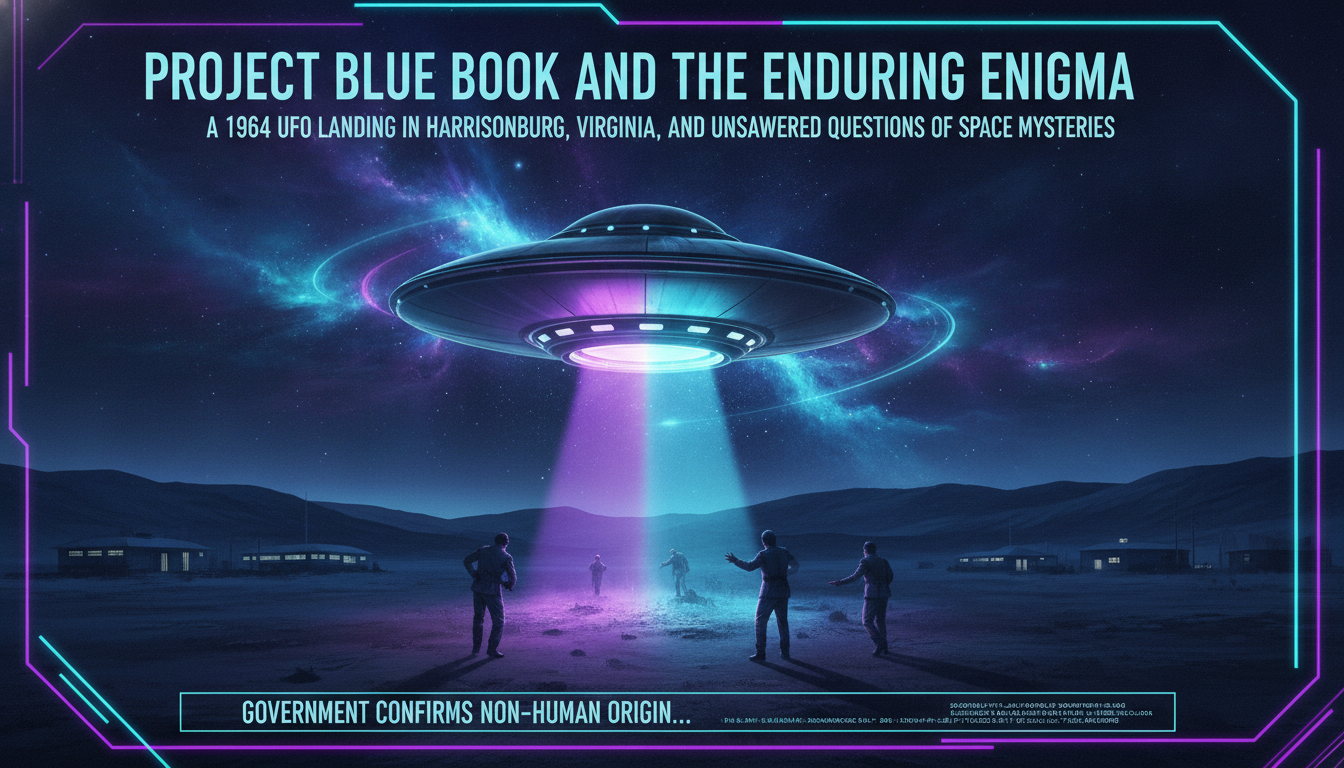
Project Blue Book and the Enduring Enigma: A 1964 UFO Landing in Harrisonburg, Virginia, and Unanswered Questions of Space Mysteries
In the annals of unexplained aerial phenomena, some cases stand out not only for their intriguing witness accounts but also for the stark discrepancies between eyewitness testimonies, preliminary investigations, and official conclusions. Among these, the alleged 1964 UFO landing in Harrisonburg, Virginia, remains a particularly compelling narrative, serving as a microcosm of the broader challenges faced by Project Blue Book and the persistent allure of space mysteries. This incident raises profound questions about the nature of official investigations into UFO sightings and the potential for a deeper reality involving extraterrestrial races.
An Unforgettable Winter Evening: Horace Burns' Astonishing Account
On a crisp winter evening, December 21, 1964, Horace Burns, a seasoned gunsmith from Harrisonburg, Virginia, embarked on a drive along Route 250 near Staunton. What began as a routine journey quickly transformed into an encounter that would forever alter his perception of reality. Burns reported witnessing an extraordinary object, a craft he meticulously described as being an astonishing 80 to 90 feet high and 125 feet in diameter, shaped distinctly like a beehive and emitting a captivating fluorescent light.
As this colossal object crossed the road ahead of his vehicle, Burns' car engine abruptly stalled, bringing his vehicle to an unnatural and immediate halt—a common, unsettling element often reported in close-proximity UFO sightings. The craft then gracefully descended, landing approximately 100 yards from the highway in a nearby meadow. It rested there for an estimated 60 to 90 seconds, an eternity for the mesmerized Burns, before ascending with a distinct sound of rushing air, vanishing into the northeast sky. His vivid account laid the groundwork for one of the most debated incidents in Project Blue Book's files.
Scientific Scrutiny: Professor Gehman's Startling Discovery
Unlike many fleeting observations, Burns' report was quickly followed by an attempt at scientific corroboration. He promptly reported the incident to Professor Ernest Gehman of Eastern Mennonite College. Recognizing the potential significance of the claim, Professor Gehman, accompanied by Burns, visited the alleged landing site. What they discovered added a critical layer of credibility to the gunsmith's incredible story.
Utilizing a Geiger counter, Gehman detected significant levels of radioactivity in the specific area where the beehive-shaped craft was said to have rested. This wasn't an isolated finding; his observations were further corroborated by two respected DuPont research engineers, Harry Cook and Mr. Funk, who joined Gehman at the site and independently witnessed the high radiation levels recorded by the Geiger counter. This immediate, on-site scientific evidence suggested something truly out of the ordinary had occurred, prompting further investigation and deepening the space mystery.
Project Blue Book's Intervention: A Divergent Narrative Begins
The compelling nature of the Harrisonburg incident soon drew the attention of the United States Air Force's Project Blue Book, the official government study of UFOs. On January 12, 1965—nearly three weeks after the initial sighting and the initial radiation findings—Technical Sergeant David Moody and Staff Sergeant Harold Jones from Wright-Patterson Air Force Base arrived to investigate. They were accompanied by Horace Burns, Professor Gehman, and Clair Weaver, then a student president of the UFO Investigators group at Eastern Mennonite College.
The Contested Radiation Readings
Sergeant Moody proceeded to test the area using a Model 2586 Beta-Gamma Survey Meter. His report concluded that there were