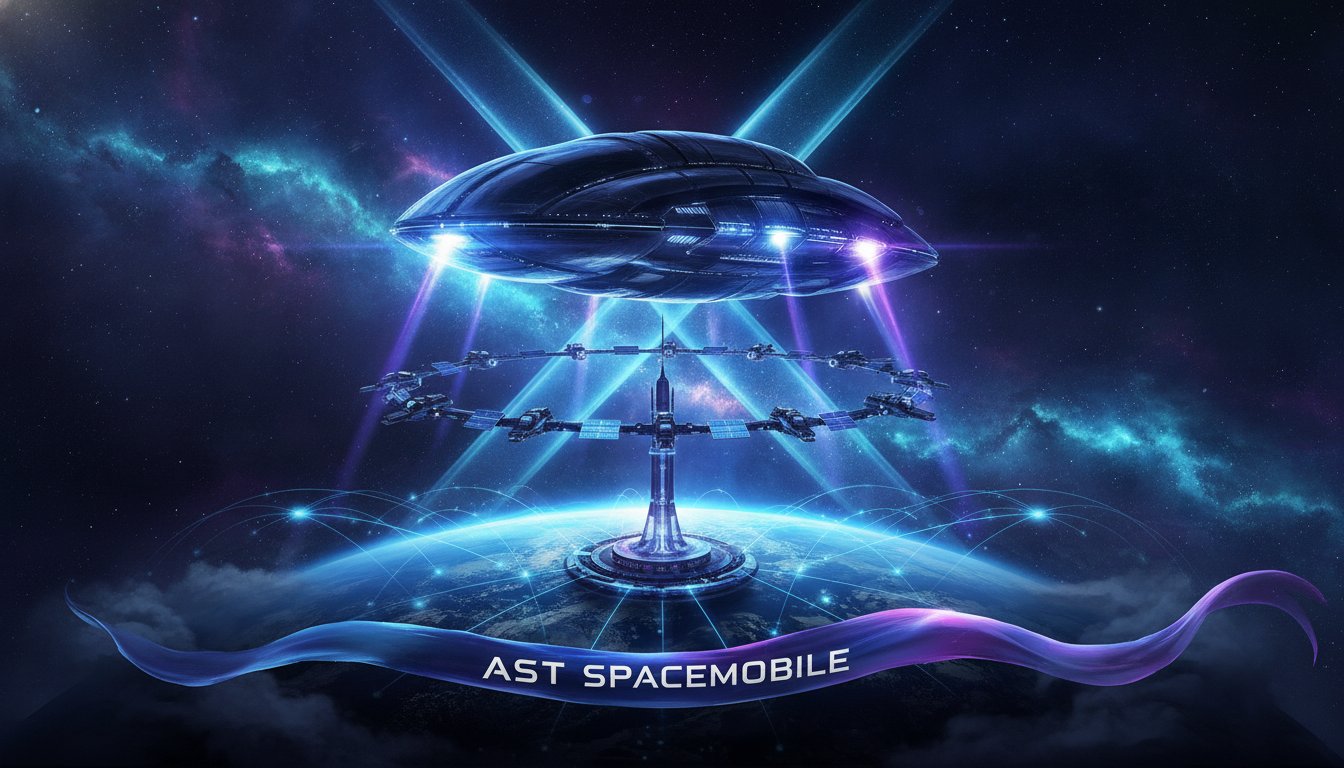
A New Frontier in Global Communication: SpaceX Launches BlueBird Satellites
The cosmos continues to captivate humanity, not just with its boundless space mysteries but also with the practical advancements that are rapidly transforming our interconnected world. Early Wednesday morning, August 5th, a pivotal moment in global communication is poised to unfold as SpaceX prepares to launch three cutting-edge BlueBird direct-to-cell satellites for AST SpaceMobile. This mission, taking off from Florida's Cape Canaveral Space Force Station during a 96-minute window opening at 3:42 a.m. EDT (0742 GMT), represents a significant stride towards ubiquitous cellular broadband coverage directly from low Earth orbit (LEO).
Revolutionizing Connectivity: Direct-to-Cell Technology
For decades, satellite communication has largely required specialized equipment. However, AST SpaceMobile is pioneering a revolutionary approach: delivering internet service directly to unmodified smartphones. This eliminates the need for bulky dishes or proprietary hardware, promising to bridge the digital divide for billions of people in underserved and remote areas. The BlueBird constellation aims to turn the dream of true global connectivity into a tangible reality, allowing users to access broadband speeds from virtually anywhere on Earth.
The BlueBird Fleet: Engineering Marvels in Orbit
This upcoming launch will deploy BlueBirds 11, 12, and 13, adding crucial capacity to AST SpaceMobile's burgeoning constellation. The company has already sent ten BlueBird spacecraft into orbit, steadily building its infrastructure. These aren't ordinary satellites; they are engineering marvels designed for unprecedented reach and performance. Initial spacecraft, categorized as "Block 1" BlueBirds, featured expansive communications arrays covering 693 square feet (64.4 square meters). These earlier iterations have already demonstrated impressive capabilities, achieving peak download speeds of 98.9 Mbps directly to standard smartphones.

However, the latest generation represents a remarkable leap forward. The "next-generation" BlueBirds, first launched with BlueBird 6 in December 2025 (aboard an Indian LVM3 rocket), boast even larger antenna arrays, spanning a staggering 2,400 square feet (223 square meters). These colossal structures are designed to deliver nearly double the peak download speeds of their Block 1 predecessors. With four next-gen BlueBirds (6, 8, 9, and 10) currently in LEO – despite the unfortunate loss of BlueBird 7 due to a Blue Origin New Glenn rocket anomaly in April – the addition of 11, 12, and 13 will nearly double the off-Earth population of these advanced satellites, significantly enhancing the constellation's overall capacity and coverage.
SpaceX: A Pillar of Reliability in Space Exploration
Entrusting this vital mission to a Falcon 9 rocket underscores SpaceX's unparalleled reliability and efficiency in the modern era of space exploration. This particular Falcon 9 first stage booster is a seasoned veteran, embarking on its 30th flight and subsequent landing. Its remarkable reusability is a testament to SpaceX's innovative engineering, a cornerstone of making space access more sustainable and cost-effective. Approximately 8.5 minutes after liftoff, the booster will execute a precision landing on the autonomous drone ship "A Shortfall of Gravitas" stationed in the Atlantic Ocean.
The Falcon 9's upper stage will then meticulously deploy the three BlueBird satellites into their designated LEO slots over an 11-minute period, commencing 53.5 minutes after launch. This precise orchestration is crucial for the successful integration of these new satellites into the existing network, further accelerating the path towards a fully operational constellation.
Towards a Connected Future: Beta Services on the Horizon
This launch is more than just another satellite deployment; it's a critical step towards realizing AST SpaceMobile's ambitious vision. Scott Wisniewski, the company's president, highlighted this on July 28th, stating, "This orbital launch, combined with expanded manufacturing capacity and the recent successful launch and deployment of BlueBird satellites 8, 9, and 10, position us for beta services later this year with our space-based cellular broadband coverage." The impending rollout of beta services signifies that the promise of direct-to-cell satellite internet is rapidly transitioning from concept to commercial reality.
As humanity continues to push the boundaries of technological innovation, these cosmic advancements are not only shrinking our world by enhancing communication but also enabling us to look further into the universe, contemplating not just the mysteries above but also the potential for future discoveries. The launch of BlueBirds 11, 12, and 13 is a testament to human ingenuity, pushing the frontiers of connectivity and opening new avenues for global interaction and understanding.


![[EN] August full moon 2026: When, where and how to see the Sturgeon Moon](/uploads/-august-full-moon-2026-when-where-and-how-to-see-the-sturgeon-moon--cover-1785866439069.jpg)

0 Comments
Login to leave a comment.