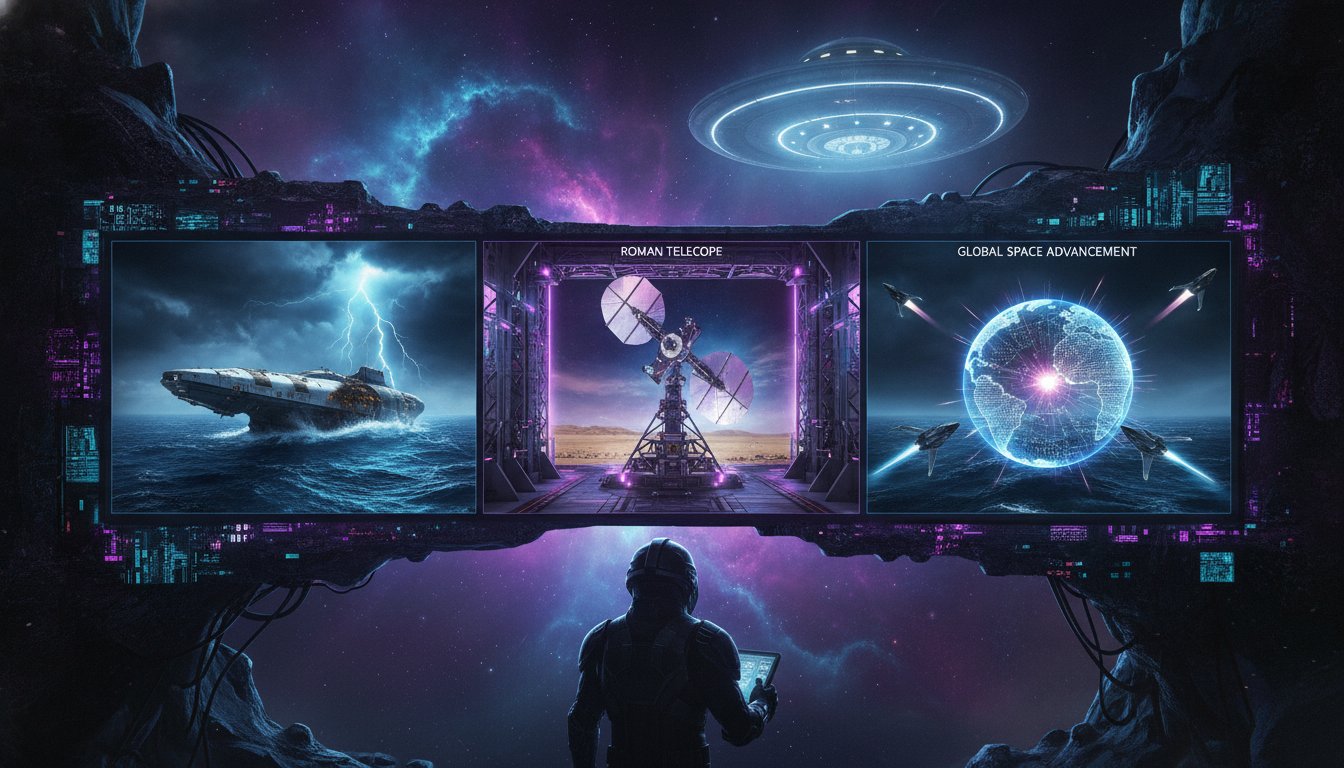
A Week of Cosmic Feats: Starship's Ocean Survival, Roman Telescope Nears Launch, and Global Space Advancements
The dynamic realm of space exploration has once again captivated audiences worldwide, marked by a series of significant milestones and intriguing developments. From groundbreaking rocket technology to the imminent deployment of next-generation observatories, humanity's reach into the cosmos is expanding rapidly, promising unprecedented insights and capabilities. This week's highlights offer a compelling snapshot of the current state of space exploration and the ambitions driving it.
SpaceX's Starship Redefines Reentry: The "Softest Splashdown"
At the forefront of recent aerospace news is SpaceX's Starship, which executed its 13th flight test with remarkable success. Beyond deploying new Starlink V3 satellites, the mission garnered significant attention for Starship's astonishing reentry and splashdown. Described as the "softest splashdown" ever, the colossal vehicle survived its fiery descent through Earth's atmosphere intact enough to float in the Indian Ocean for days. This unprecedented resilience has provided invaluable data for SpaceX, demonstrating a significant leap towards their goal of fully reusable spaceflight. The sight of the colossal Starship remaining buoyant, gathering imagery from recovery teams, underscored the potential of this ambitious vehicle.
However, the path to rapid reuse is not without its challenges. Experts continue to highlight that current Starship heat shield technology may be a "dead end" for the desired high-frequency, cost-effective reflights. Despite these engineering hurdles, SpaceX's momentum remains strong, evidenced by their recent win of $1.6 billion in launch orders for military satellite networks, solidifying their position as a pivotal player in both commercial and governmental space endeavors.
NASA's Next Frontier: The Roman Space Telescope Prepares for Launch
Meanwhile, NASA is on the cusp of launching its next great observatory, the Nancy Grace Roman Space Telescope. With its launch slated for late August, the scientific community eagerly anticipates the capabilities of this revolutionary instrument. Designed to delve into some of the universe's most profound mysteries, including dark energy, dark matter, and the search for exoplanets, the Roman Space Telescope is expected to achieve feats currently deemed "impossible" by existing technology. Its wide field of view and high-resolution imaging promise to unlock new perspectives on the structure and evolution of the cosmos, building upon the legacies of Hubble and Webb. The meticulous fueling process is complete, signaling its readiness for its monumental journey.
Critical Missions and Persistent Delays: Swift, Starliner, and Artemis
Not all missions proceed without complications. An emergency effort is currently underway to salvage the ailing Swift Space Observatory, a vital instrument for detecting gamma-ray bursts. Compounding the challenge, the servicing spacecraft dispatched for the rescue mission is itself encountering technical difficulties, underscoring the inherent risks and complexities of deep space operations.
On the human spaceflight front, Boeing's Starliner program continues to face frustrating delays. While its maiden crewed flight has been repeatedly postponed, there remains optimism that the capsule might finally make its way into space later this year. This long-awaited milestone is crucial for NASA's commercial crew program, offering another independent means of transporting astronauts to the International Space Station.
Beyond low Earth orbit, the Artemis program, aiming to return humans to the Moon, also sparks ongoing debate. Discussions persist regarding the optimal landing site for Artemis IV astronauts, with some experts, including the Artemis II pilot, suggesting the lunar equator might offer advantages over the previously targeted south pole, initiating important strategic conversations for future lunar exploration.
The Dawn of a New Space Era: India's Private Orbital Success
In a testament to the global expansion of space capabilities, India celebrated a significant achievement with Skyroot Aerospace's Vikram-1 rocket. This successful debut marked India's first private orbital launch, ushering in what many describe as "the dawn of a new space era" for the nation. Such advancements signify a democratization of access to space, fostering innovation and competition on a global scale.
Looking Further Afield: Exomoons and Celestial Spectacles
Beyond these major developments, astronomers are abuzz with the potential discovery of the first moon outside our solar system, a finding that could redefine our understanding of planetary systems. Adding to the intrigue, a SpaceX rocket is scheduled for an unintentional lunar impact next week, prompting scientists to ponder the scientific insights this unexpected event might yield. For skygazers, August promises an "almost blood moon" lunar eclipse and the Perseid meteor shower in 2026, ensuring celestial beauty for years to come.
The week's events paint a vivid picture of a bustling, ambitious, and increasingly accessible space frontier. From engineering marvels to groundbreaking scientific instruments, humanity's quest to explore and understand the universe continues with relentless vigor.
0 Comments
Login to leave a comment.