Unveiling the Cosmic Enigma: Nysa, the First 'Three-Headed' Asteroid with a Moon
For centuries, the vast expanse of our solar system has whispered secrets, revealing its wonders gradually through the lens of human curiosity and technological advancement. Yet, few discoveries ignite the imagination quite like the recent revelation surrounding asteroid (44) Nysa. Astronomers, peering through some of Earth's most powerful telescopes, have unveiled Nysa not merely as another celestial body, but as the first-known "trilobate" or "three-headed" asteroid in our cosmic neighborhood, complete with its own diminutive moon. This unprecedented finding is rewriting our understanding of asteroid morphology and hinting at the chaotic, dynamic processes that shaped our planetary home.
The Genesis of a Remarkable Discovery
First cataloged in 1857, Nysa has long been a known resident of the main asteroid belt, a bustling cosmic highway situated between the orbits of Mars and Jupiter. However, its true, astonishing form remained hidden until a new generation of observational prowess brought it into sharp focus. Utilizing the formidable capabilities of the Very Large Telescope in Chile and the Large Binocular Telescope in Arizona, scientists recently captured images of Nysa in unprecedented detail. These cutting-edge observations pierced through the veil of distance, resolving a structure so peculiar that it immediately captivated the astronomical community.
Anomaly in Form: The Trilobate Structure
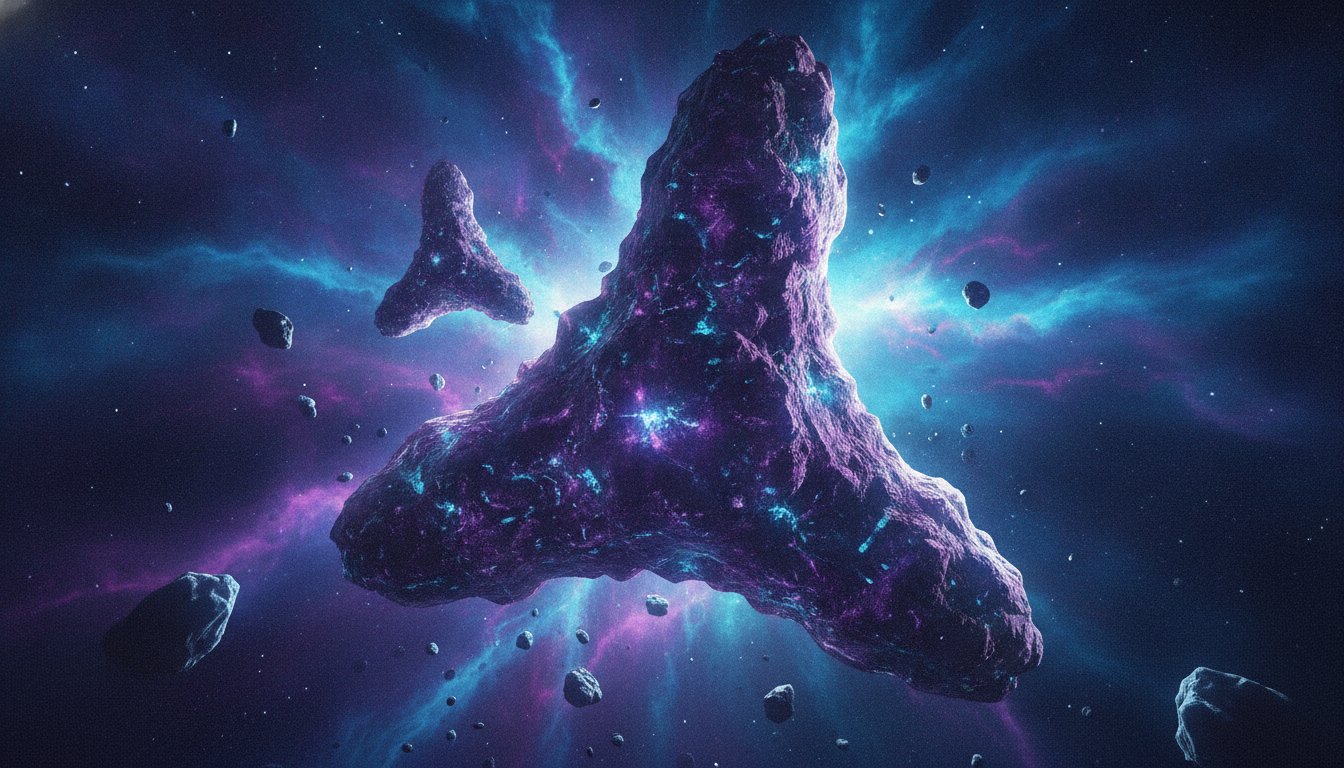
What distinguishes Nysa from the countless other asteroids we've charted? Its extraordinary "trilobate" or three-lobed shape is unlike anything previously documented. Measuring approximately 47 miles (75 kilometers) in circumference at its widest point, Nysa presents a bizarre silhouette characterized by two distinct, narrow "necks" that connect its three seemingly separate masses.
Kate Minker of Arizona's Lowell Observatory, a key figure in the discovery, articulated the profound uniqueness of this find: "The images reveal a remarkably unusual object. The most likely explanation is that Nysa is either a contact trinary, consisting of three connected components, or an extremely irregular coherent body unlike anything we've previously observed." A "contact trinary" suggests three distinct bodies gently touching and gravitationally bound, while an "irregular coherent body" would imply a single, unusually shaped entity. Either explanation points to a formation process far more complex and violent than typical asteroid evolution. Such shapes could arise from slow-motion collisions, rotational instabilities, or the unusual accretion of material in the early solar system.
Nysa's Unexpected Companion: S/2026 (44) 1
Adding another layer to Nysa's mystique is the discovery of its own small moon, designated S/2026 (44) 1. This tiny satellite, a mere 0.6 miles (1 kilometer) wide, appears to gracefully orbit Nysa at a distance of approximately 106 miles (170 kilometers). While binary asteroids (asteroids with one moon) are known, the presence of a moon orbiting such a uniquely shaped primary body makes Nysa even more compelling. The dynamics between a trilobate asteroid and its moon present a fascinating gravitational puzzle for astronomers to unravel, potentially offering insights into orbital stability in highly irregular gravitational fields.
Decoding the Solar System's Early Chapters
Beyond its striking appearance, Nysa holds significant scientific value as a celestial "time capsule." Asteroids are primordial remnants from the dawn of our solar system, preserving clues about the conditions and materials present during its formation some 4.5 billion years ago. Nysa is particularly intriguing because it belongs to a class of asteroids believed to have formed closer to the inner solar system, a region where the rocky planets — Mercury, Venus, Earth, and Mars — took shape.
By studying Nysa's composition, scientists hope to gain a deeper understanding of the building blocks that coalesced to form these inner planets. Its unusual structure could also shed light on the impact histories and evolutionary pathways of early planetary bodies. Each crater, each irregular lobe, each orbiting fragment tells a story of cosmic collisions, gravitational dances, and the slow, inexorable march of material aggregation that eventually led to the worlds we know.
A Glimpse into Ongoing Cosmic Mysteries
The discovery of the "three-headed" asteroid Nysa and its moon serves as a potent reminder of the boundless mysteries that still reside within our own solar system. With every new observation from advanced telescopes like the Very Large Telescope and the Large Binocular Telescope, our understanding of the cosmos deepens, pushing the boundaries of what we thought possible. Nysa stands as a testament to the dynamic and often surprising nature of celestial mechanics, inviting astronomers and enthusiasts alike to ponder the untold stories held within these ancient wanderers of space. Its unique form challenges existing models and promises to unlock new secrets about the origins of planets and the intricate architecture of the cosmos.
0 Comments
Login to leave a comment.