Unveiling the Enigma: Hubble and James Webb Locate the First of Omega Centauri's "Missing" Black Holes
For decades, astronomers have theorized the existence of a teeming population of stellar-mass black holes lurking within Omega Centauri, the most massive and mysterious globular cluster in our Milky Way galaxy. Estimates suggested as many as 10,000 of these cosmic behemoths might be present, born from the spectacular deaths of massive stars. Yet, despite dedicated searches, these elusive objects remained largely undetected—until now. A groundbreaking collaboration between the venerable Hubble Space Telescope and the revolutionary James Webb Space Telescope (JWST) has finally pinpointed the first of these long-sought black holes, opening a new chapter in our understanding of the universe's most extreme environments.
The Decades-Long Hunt Culminates in Discovery
The journey to finding this particular black hole, designated oMEGACat BH-2, was a testament to persistent observation and sophisticated analysis. Researchers observed a seemingly ordinary star in a binary system, meticulously tracking its movements over an astonishing 20-year period. Data from Hubble spanned from 2003 to 2023, with the JWST providing critical follow-up observations to refine the precise measurements. What they saw was a star orbiting something undeniably massive but entirely dark, a tell-tale sign of an invisible companion exerting immense gravitational pull.
Initial studies had hinted at the possibility of a neutron star, another type of dense cosmic remnant, but the new, highly accurate data left no room for doubt. The dark object was calculated to possess a mass 4.46 times that of our Sun. This measurement unequivocally places it beyond the theoretical upper limit for a neutron star, confirming its identity as a stellar-mass black hole.
Omega Centauri: A Galaxy in Disguise?
Omega Centauri itself is a celestial marvel, located approximately 18,000 light-years from Earth and housing an astonishing 10 million stars. Its immense size and star density are so extraordinary that many astronomers believe it isn't merely a globular cluster but rather the stripped-down core of a dwarf galaxy that was gravitationally "cannibalized" by the Milky Way billions of years ago. This hypothesis gained significant traction in 2024 when the Hubble Space Telescope found compelling evidence for an intermediate-mass black hole—approximately 8,200 times the mass of our Sun—at Omega Centauri's very center. The presence of a central black hole is characteristic of galaxies, not typical star clusters, further bolstering the dwarf galaxy remnant theory.
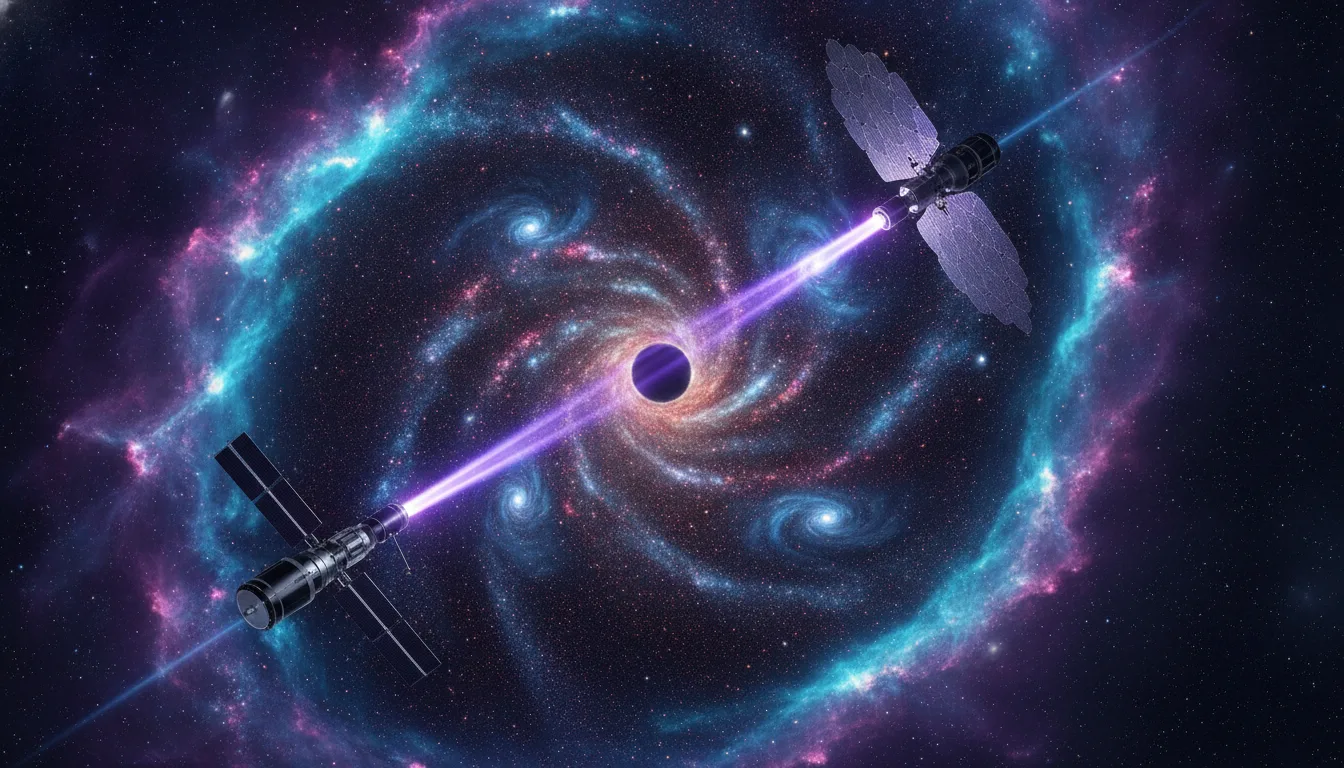
The discovery of oMEGACat BH-2, a stellar-mass black hole, now adds another layer of complexity and confirmation to this compelling narrative. Stellar-mass black holes are the natural byproduct of the evolution of massive stars, and finding them within Omega Centauri aligns with the expectation for such a dense and ancient stellar environment.
Astrometry and the "Mass Gap" Enigma
The team, led by Matthew Whitaker of the University of Utah, employed a technique known as astrometry. This method involves precisely measuring the minute changes in a star's position as it moves through space, allowing astronomers to infer the gravitational influence of unseen companions. The detected star, about 78% the mass of our Sun, traces a remarkably wide, 94-year orbit around oMEGACat BH-2. Crucially, the 20 years of Hubble observations coincided with the star's closest approach to the black hole, a period when its motion was most accelerated, enabling exceptionally precise gravitational field measurements.
"The precision of these measurements is incredible, down to a fraction of a pixel on Hubble and Webb's detectors," Whitaker stated, underscoring the indispensable role of both space telescopes.
What makes oMEGACat BH-2 particularly intriguing is its mass. At 4.46 solar masses, it falls squarely within a puzzling "mass gap." Gravitational wave detections from merging black holes over the past decade have revealed a conspicuous absence of black holes with masses between 2.5 and 5 times that of the Sun—a range theoretically too massive for a neutron star but seemingly too light for many observed stellar-mass black holes. oMEGACat BH-2 now occupies this previously "empty" zone, offering a vital piece of the cosmic puzzle.
Unlocking Black Hole Formation and Evolution
"It's important to understand black hole populations in globular clusters because there's uncertainty about their physics and formation," explained Anil Seth, also from the University of Utah. The primitive chemical composition of Omega Centauri's stars—with fewer elements heavier than hydrogen and helium—adds another layer of complexity. How such stars produce black holes in supernova explosions is an active area of research, and oMEGACat BH-2’s presence within the mass gap, originating from a low-metallicity progenitor, challenges existing models.
This singular discovery is just the beginning. With one black hole found, an estimated 9,999 or so still await identification. Whitaker's team continues to pore over Hubble and JWST data. Furthermore, the upcoming launch of NASA's Nancy Grace Roman Space Telescope promises even greater capabilities. Its wide field of view and Hubble-like resolution will be ideal for regularly imaging crowded galactic regions, potentially uncovering numerous other black hole binary systems like oMEGACat BH-2, shedding more light on these enigmatic denizens of the cosmos. The paper detailing these findings was published on July 13 in The Astrophysical Journal Letters.
0 Comments
Login to leave a comment.