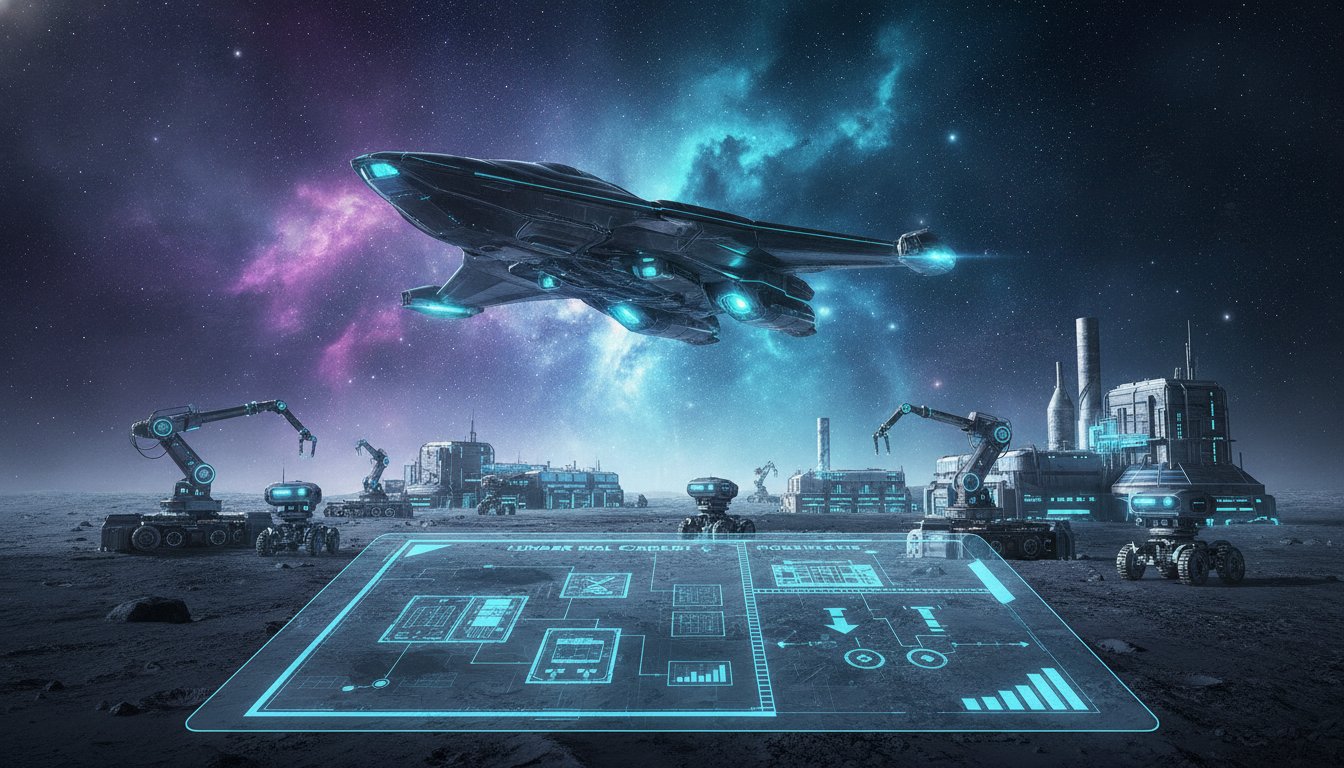
SpaceX's Bold Vision: Building Factories on the Moon with Robots and AI
Elon Musk's SpaceX continues to push the boundaries of what's considered achievable in space, now setting its sights on an audacious plan to establish manufacturing facilities on the Moon. This isn't just a distant dream; Musk recently reiterated this vision, confirming the company's serious intent to investors during its inaugural quarterly earnings call on August 4. The goal: to construct advanced factories on the lunar surface, largely operated by robots, to produce a vast constellation of AI-powered satellites.
A Moon-Based Industrial Revolution
The core of SpaceX's lunar initiative revolves around the creation of its "Starmind" AI satellites. Musk envisions a future where these sophisticated craft, initially numbering a million strong in Earth orbit, will eventually extend their reach far beyond. The lunar factories would be instrumental in this expansion, fabricating crucial components like solar panels for power generation and radiators to dissipate the significant heat produced by the satellites in the vacuum of space.
"We are going to land a lot of tonnage on the moon," Musk declared, emphasizing the scale of the operation. "We're going to build the factories on the moon. The robots will be helpful with that." This vision, first publicly outlined in a February blog post announcing SpaceX's acquisition of xAI – an artificial intelligence company founded by Musk in 2023 – highlights off-Earth manufacturing as a central pillar of the company's long-term strategy.
The concept is undoubtedly futuristic, prompting Musk himself to acknowledge, "I know it sounds, like, super sci-fi right now, but it's going to happen." He detailed plans to utilize electromagnetic mass drivers – essentially powerful rail guns – to launch locally made Starmind satellites directly from the lunar surface. Such a system, combined with lunar solar and radiator production, could potentially "scale to 1,000 times the economy of Earth in terms of intelligence launched to space, but probably, you know, maybe even a million times," a truly staggering projection of an off-world economy.
Optimus and Starship: The Pillars of Lunar Ambition

While specific details regarding the lunar robotic workforce remain sparse, it's widely speculated that Tesla's humanoid robot, Optimus, will play a significant role. Musk has previously indicated plans to deploy Optimus units to Mars to aid in human settlement preparations, making their involvement in lunar factory construction a logical next step. These advanced robots are expected to handle much of the heavy lifting and intricate assembly work, laying the groundwork for a truly autonomous lunar industrial base.
Crucial to the entire endeavor is SpaceX's Starship, its fully reusable next-generation megarocket. Starship is not merely a transport vehicle; it is the cornerstone of virtually all of SpaceX's ambitious plans, both in Earth orbit and deep space. "Starship aims to quadruple payload capacity and reduce launch costs by 10 times compared to our Falcon 9 rocket, unlocking significant capabilities across all of our business segments," explained SpaceX Chief Financial Officer Bret Johnsen during the earnings call.
To support the envisioned lunar operations and a multitude of other missions, SpaceX is rapidly scaling up its Starship infrastructure. This includes accelerating the production of Raptor engines, expanding its "gigabays" (manufacturing facilities), and activating multiple launch pads at Starbase in South Texas, as well as at Cape Canaveral's Pad 39A and Pad 37. The ability to conduct thousands of Starship launches per year is deemed essential for realizing the lunar factory vision.
SpaceX's Financial Trajectory: Fueling the Future
The August 4 earnings call was a pivotal moment for SpaceX, marking its first as a publicly traded company. After its historic IPO in June, which raised $86 billion and valued the company at an astronomical $1.77 trillion, SpaceX solidified its position among the elite tier of American corporations, surpassed only by giants like NVIDIA, Apple, Alphabet, Microsoft, Amazon, and Broadcom at the time.
The company's second-quarter earnings report revealed robust growth, with revenues soaring to $7.8 billion – a remarkable 92% increase over the same period in 2025. While SpaceX did report a loss of $541 million for Q2 2026, this figure represents a substantial improvement from the $1.0 billion loss incurred in Q2 2025, signaling a positive financial trajectory as the company continues to invest heavily in its groundbreaking projects.
Elon Musk's vision for lunar factories and a self-sustaining off-world economy, once relegated to the realm of science fiction, is now backed by tangible engineering progress and formidable financial power. With Starship rapidly advancing and a clear strategy for robotic lunar construction, SpaceX is not just dreaming about the Moon; it's actively planning to build its future there, paving the way for unprecedented expansion of humanity's technological footprint into the cosmos.


![[EN] Inside the mystery of the James Webb Space Telescope's little red dots — and how they might be evolving](/uploads/-inside-the-mystery-of-the-james-webb-space-telescopes-little-red-dots-and-how-they-might-be-evolving--cover-1786126841167.jpg)
0 Comments
Login to leave a comment.