
“Flight of the Navigator” at 40: A Sci-Fi Classic That Mastered Time Dilation
As it marks its 40th anniversary, the beloved Disney film “Flight of the Navigator” stands as a testament to intelligent, family-friendly science fiction, a cinematic journey that dared to tackle the mind-bending complexities of time dilation years before blockbusters like “Interstellar” captivated audiences with similar concepts. In an era where faster-than-light travel often appears effortlessly simple on screen, this 1986 gem grounded its fantastical premise in genuine scientific theory, offering a surprisingly sophisticated exploration of relativistic effects.
The Unforeseen Journey: David’s Eight-Year Leap
The core of “Flight of the Navigator” revolves around 12-year-old David Scott Freeman, portrayed by Joey Cramer. On a fateful July 4, 1978, David suffers a minor fall into a ditch near his Florida home. What seems like mere moments of unconsciousness for David turns into an eight-year void for the rest of the world. He wakes to find a dramatically altered reality: strangers in his home, his younger brother now older than him, and the curious advent of music videos on MTV. David has become an unwitting victim of time dilation, a phenomenon where time passes differently for observers in relative motion, especially at speeds approaching light.
NASA scientists in the film explain David’s predicament through “light speed theory,” positing that “time slows down as you approach the speed of light.” This central concept, while simplified for a younger audience, echoes Albert Einstein’s general theory of relativity. David’s profound displacement mirrors the emotional and physical toll experienced by characters like Matthew McConaughey’s Cooper in “Interstellar,” highlighting the personal cost of interstellar travel and its relativistic implications. The film posits that David made a round trip to the distant planet Phaelon, some 560 light-years away, in a mere 4.4 solar hours — an impossibility without bending the fabric of spacetime.
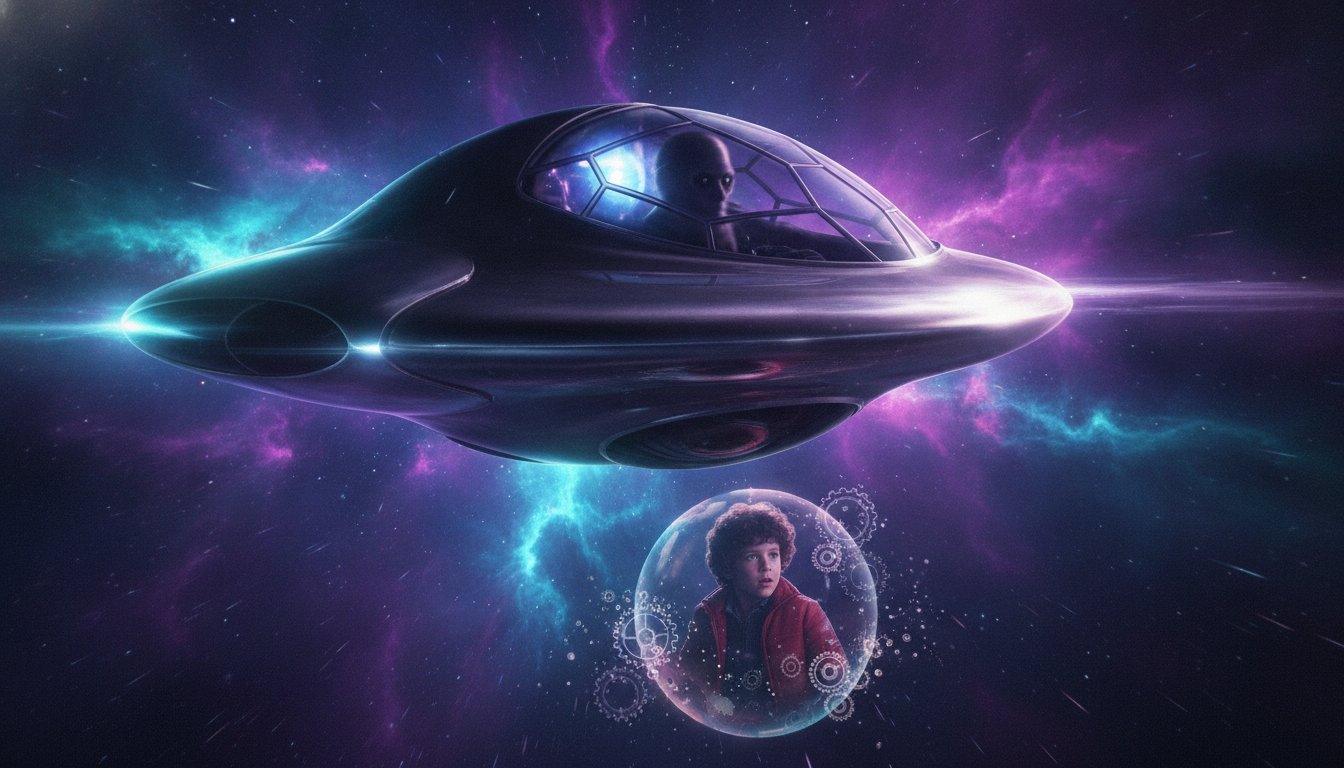
The Trimaxion Drone Ship: A Revolutionary UFO Design
David’s extraordinary journey was facilitated by an advanced extraterrestrial spacecraft, the Trimaxion drone ship, affectionately nicknamed Max and voiced by Paul Reubens. This intelligent vessel, on a mission to gather alien species for study on Phaelon, inadvertently trapped David in its relativistic journey. The ship’s damage, sustained during a collision, forces Max to rely on the star maps and alien languages he uploaded into David’s brain, transforming the young boy into an essential part of their escape from a top-secret NASA facility. This dynamic duo forms an unlikely friendship, dodging authorities in a thrilling space adventure.
Beyond its narrative function, the Trimaxion ship itself was a groundbreaking achievement in sci-fi cinema. Director Randal Kleiser, known for “Grease,” faced a creative tug-of-war with Disney, who desired a whimsical family film, and Producers Sales Organization, who sought a grittier narrative involving the military. The eventual compromise retained the film’s surprisingly bleak emotional opening but allowed for a unique vision of the spacecraft. Kleiser famously defied advice from George Lucas, who warned against the complexity of reflective surfaces. Inspired by a silver truck on a freeway, Kleiser envisioned a mirrored, shapeshifting UFO, an evolution of the classic flying saucer. With the help of his brother Jeff, a pioneer in computer graphics (who worked on “Tron”), the team achieved liquid metal effects that, while predating James Cameron’s “Terminator 2” by five years, showcased an innovative use of nascent CGI, pushing the boundaries of visual effects for its time.
A Cult Classic That Endures
“Flight of the Navigator” initially struggled at the box office, a fate director Kleiser attributed to marketing challenges. However, the film found its true audience and achieved cult classic status through home video releases. Its enduring appeal lies in its refusal to talk down to its audience, presenting complex scientific ideas and genuine emotional depth within a family adventure framework. The film thoughtfully explores themes of displacement, family bonds strained by unimaginable circumstances, and the wonder of extraterrestrial technology.
Forty years on, “Flight of the Navigator” remains a beloved entry in the pantheon of sci-fi films. It’s a reminder that a well-crafted story, combined with innovative visual effects and a willingness to embrace challenging scientific concepts, can create a lasting legacy. It’s an adventure that masterfully blends the awe of space mysteries with the heartfelt journey of a boy trying to find his way home, leaving audiences to ponder the true nature of time and the universe’s vast, unexplored reaches.



0 Comments
Login to leave a comment.