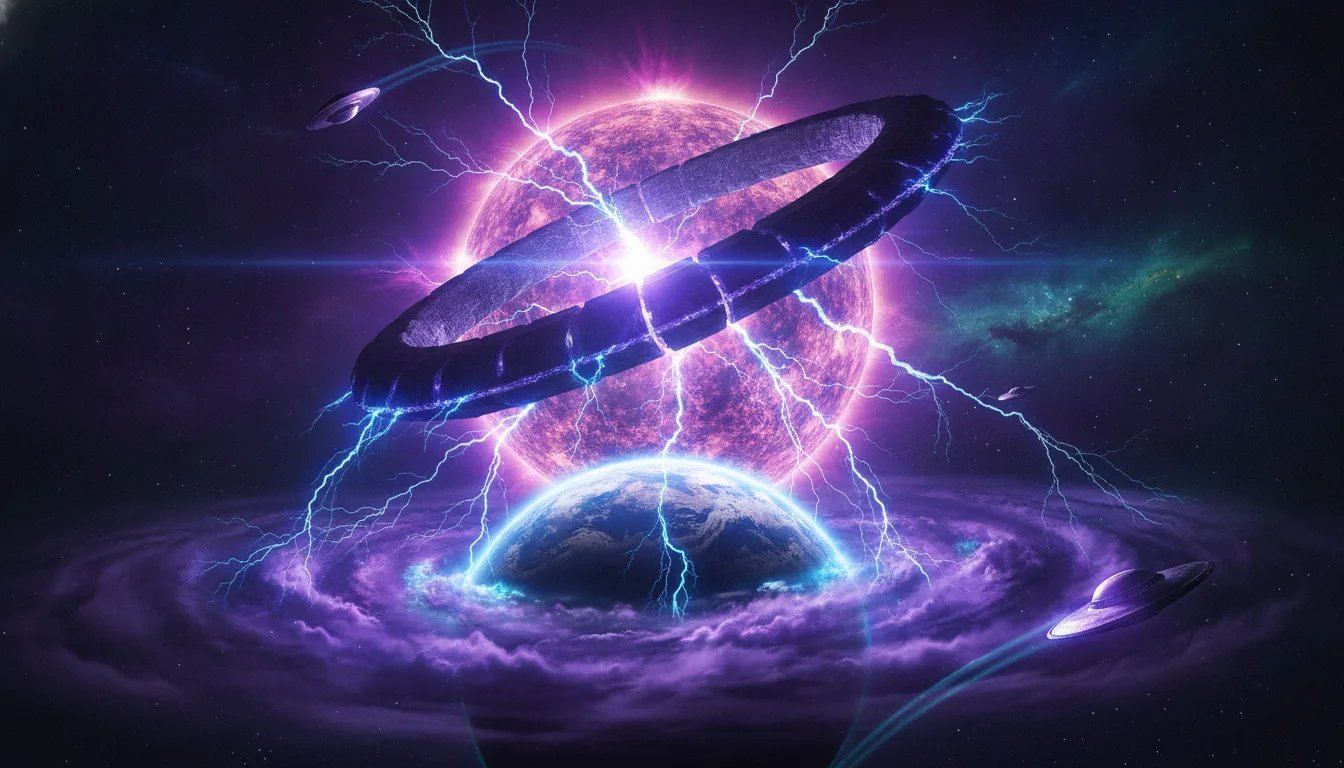
The Hidden Power of the Sun: Are We Underestimating Extreme Solar Storms?For centuries, humanity has gazed upon the sun as a life-giving force, yet beneath its radiant surface lies a power capable of disrupting our most advanced technologies. New scientific findings suggest that the true destructive potential of the most powerful solar storms, often dismissed as rare anomalies, may be far greater than previously understood, posing an unprecedented challenge to our increasingly digitized world. This provocative research compels us to reconsider our preparedness for what could be a "once-in-a-thousand-year" cosmic event.### Rethinking the "Upper Limit" of Space WeatherA recent study published in the prestigious journal Nature has cast a critical eye on the methods used to assess the severity of extreme space weather phenomena. Led by researchers including Maria Walach from Lancaster University, the study posits that our current understanding of how Earth's upper atmosphere responds to intense solar wind may be fundamentally flawed. For years, scientists observed an apparent "upper limit" to this response, leading to the assumption that beyond a certain point, Earth's magnetic field provided sufficient protection. However, Walach and her team argue this perceived limit is an artifact of measurement techniques rather than a true physical ceiling.Many crucial observations of extreme solar wind events are collected by spacecraft positioned at the Sun-Earth Lagrange Point 1 (L1), roughly 1 million miles (1.5 million kilometers) upstream of Earth. The core of the new hypothesis is that the strongest solar winds tend to weaken somewhat during their journey from L1 to Earth. This subtle attenuation could give the misleading impression that our planet's atmosphere stops responding to increasingly intense solar wind, even when, in reality, it does not.### When the Sun Lashes Out: Understanding Solar StormsSolar storms are cataclysmic eruptions from the sun's surface, primarily manifesting as coronal mass ejections (CMEs) and solar flares. These events unleash vast clouds of charged particles and intense radiation, hurtling them across the vast expanse of space. While Earth's magnetic field acts as a formidable shield, deflecting the majority of these particles and treating us to spectacular auroras, exceptionally powerful storms can overwhelm these defenses. The consequences can range from minor glitches to widespread technological paralysis.### Echoes from the Past: Historical WarningsHistory provides stark warnings of the sun's capacity for disruption. The 1859 Carrington Event stands as the most powerful geomagnetic storm on record, a benchmark for space weather intensity. It caused widespread telegraph system failures globally and painted skies as far south as the tropics with vibrant auroras. More recently, in 1989, a powerful solar storm plunged Quebec into darkness, collapsing its entire power grid and leaving millions without electricity. The "Halloween storms" of 2003, though less severe, still disrupted satellites, GPS, and radio communications, demonstrating the vulnerability of modern infrastructure. Even the recent May 2024 geomagnetic storm, the strongest in over two decades, highlighted these vulnerabilities by causing intermittent disruptions to high-frequency radio and GPS-guided equipment, albeit on a much smaller scale than the Carrington Event.### A New Perspective: Measurements Closer to HomeTo challenge the L1 measurement bias, the research team analyzed over a million solar wind measurements from NASA spacecraft orbiting significantly closer to Earth, where the solar wind directly interacts with our planet's magnetic field. These observations revealed a crucial insight: electrical currents flowing through Earth's upper atmosphere continued to increase proportionally with stronger solar wind, showing no sign of the previously assumed "upper limit." This finding fundamentally changes our understanding, suggesting that "once-in-a-thousand-year" solar storms could generate geomagnetic disturbances and subsequent impacts on satellites, communication systems, and power grids far exceeding current predictions.### The Imperative for Preparedness in the Solar Maximum EraWhile the study does not predict an imminent, unprecedented solar storm, it serves as a critical call to action. As the sun approaches the peak of its roughly 11-year solar cycle, known as solar maximum, solar flares and coronal mass ejections are becoming more frequent. This heightened activity underscores the urgency for scientists and policymakers to reassess risk models and enhance resilience against extreme space weather events. Our societal dependence on vulnerable technologies — from global communication networks to precision navigation systems — demands a more robust understanding and preparedness strategy for the hidden, yet profound, power emanating from our nearest star. The future of our interconnected world may well depend on our ability to accurately gauge and mitigate these cosmic threats.
solar storms
geomagnetic storms
space weather
Carrington Event
power grid disruption
satellite vulnerability
solar maximum
cosmic threats



0 Comments
Login to leave a comment.